
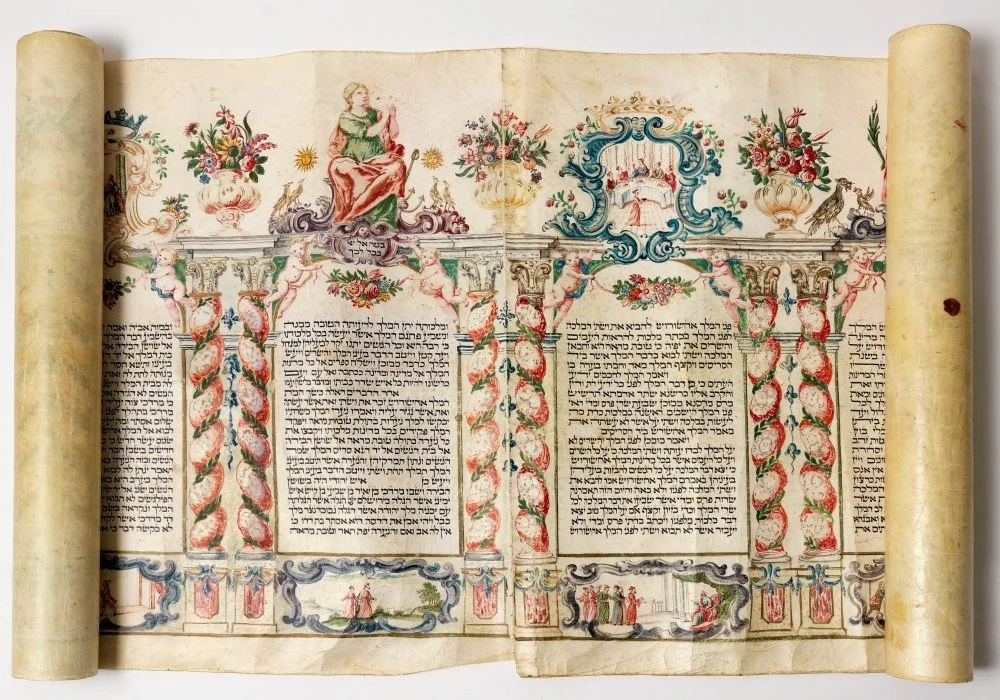
Megillat Esther, Scroll of Esther. theTorah.com
A D’var Torah for Tetzaveh and Zachor
Rabbi Paul L. Saal, Congregation Shuvah Yisrael, West Hartford, CT
The Torah portion for this week, Tetzaveh (Exodus 27:20-30:10), literally means “you shall command,” and it conveys the most imperative sense of divine instruction. It continues God’s detailed directions for the building and operation of the Mishkan, the unique sanctuary in which Hashem promises to dwell with Israel during our travels through the wilderness. It represents far more than a temporary structure to occupy or instruct the people along a difficult journey. Rather, it becomes the sacred meeting place where heaven and earth touch, and where Israel learns who we are and why we exist.
The precision with which the Holy One commands Israel through Moses suggests that the Mishkan reflects nothing less than the completion of creation itself. Just as Genesis describes God bringing order out of chaos, so here every measurement, material, and detail is carefully ordered. Nothing is accidental. Every board, every vessel, every half cubit matters. The sages even observed that the language of the Mishkan echoes the language of creation, teaching that the sanctuary functions as a miniature world, a microcosm of creation (Midrash Tanchuma, Pekudei 2). In this way, Israel is invited to participate in finishing what began in Eden by preparing a dwelling place for the Divine Presence.
This portion gives instructions concerning the incense, the altar, the menorah, and the vestments of the kohanim, Israel’s priestly legacy. If one were to borrow theatrical language, the Mishkan resembles a sacred drama. The mood, the lighting, and the costumes are prepared with intention. Hashem is the author and producer; Moses directs; Aaron and his sons serve; and Israel becomes the cast. For nearly forty years, day after day, our ancestors enacted a traveling testimony that through sacrifice and kavanah (intentional prayer and devotion) the Glory of Hashem could be brought into this world and the light of Olam HaBa (the Age Come) could illuminate ordinary life, as we see when the cloud fills the Tabernacle at the end of Exodus.
Yet the Torah does not romanticize the story. Like all human endeavors, the drama of the Mishkan is complicated by human frailty. The performers forget their lines. Nadav and Avihu bring “strange fire” (Lev 10:1). Korach competes for a role that was never his (Num 16:1–3). The people grumble and lose heart. Again and again, they forget why they are there. They forget that they were called to be a kingdom of priests and a holy nation. Their lives were meant to serve God, creation, and humanity, not themselves.
That theme of forgetting leads directly into the second reading of the week. When Tetzaveh coincides with Shabbat Zachor, the Sabbath of Remembrance, we read the maftir portion that precedes Purim:
Remember what Amalek did to you on the way when you came out of Egypt … you shall blot out the memory of Amalek from under heaven. You shall not forget. (Deut 25:17–19)
At a historical level, the connection is clear. Haman, the antagonist of the Purim story, is a descendant of Amalek, and both sought Israel’s destruction through treachery. Yet the commandment is deeper than history alone. The Gemara teaches that we must remember Amalek with the mouth and not forget in the heart (Megillah 18a). Remembrance is therefore not merely intellectual. It is verbal and emotional. We speak the memory aloud and we internalize it so that our hearts develop a moral revulsion toward cruelty and evil. The Sefer HaChinuch explains that this mitzvah trains the soul to resist wickedness wherever it appears.
Amalek thus becomes more than an ancient nation. Amalek symbolizes spiritual fatigue and doubt. Rashi, citing the Midrash, says that Amalek “cooled off” Israel’s awe after the Exodus, weakening our sense of wonder and trust. Amalek attacked the stragglers, the weary and distracted, those who had fallen behind. The message is clear. When we lose focus, when we grow complacent, when we forget who we are, we become vulnerable.
This is precisely what the Mishkan was designed to prevent. The daily offerings, the priestly garments, the lamps, the incense, and the rhythms of worship continually rehearse Israel’s identity. They train the heart to remember. Tetzaveh establishes a liturgy of sacred purpose, and Zachor warns us what happens when memory fades. Together they teach that holiness requires intentional remembrance.
For Messianic believers, these themes reach their fulfillment in Yeshua. The New Covenant presents him as both Kohen and offering, the greater High Priest who ministers in the heavenly sanctuary, as described in Hebrews. Yochanan writes that the Word became flesh and dwelt among us, literally “tabernacled” among us. The Mishkan points forward to the ultimate dwelling of God with humanity. At his final meal Yeshua gives a command that echoes Zachor itself, “Do this in remembrance of me.” Once again, memory becomes covenant faithfulness embodied in action.
If Amalek represents forgetfulness, Messiah restores remembrance. If the wilderness generation forgot their lines, we are called to rehearse them daily. Build the sanctuary. Light the lamps. Guard the heart. Remember the calling placed upon us.
Parashat Tetzaveh and Shabbat Zachor together offer a simple but urgent charge. Remember who you are. Remember whom you serve. Remember why you were redeemed. And do not forget.