
“Therefore, Choose Life”
Parashat Nitzavim-Vayelech, Deuteronomy 29:9–31:30
Rabbi David Tokajer, Congregation Mayim Chayim, Daphne, Alabama
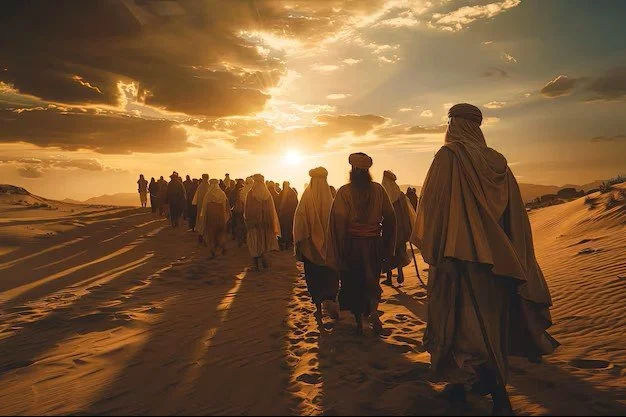
Parashat Nitzavim-Vayelech takes us to one of the Torah’s most moving moments. Israel stands on the plains of Moab, with the wilderness behind and the Promised Land ahead. Moses, who led them from Egypt, knows he will not cross the Jordan with them. And his opening words are significant: “You are standing today, all of you, before Adonai your God” (Deuteronomy 29:9).
The Hebrew word nitzavim means more than just being present. It suggests standing firmly, being established, and being set in place. Israel stands before Adonai as a covenant people.
Notice who is present: leaders, elders, officials, men, women, children, and even the strangers living among them. Everyone is included in this covenant moment. Even more, Moses says the covenant is made “not with you alone” but also “with whomever is standing here with us today before Adonai our God and with whomever is not here with us today” (Deuteronomy 29:13-14).
This means the covenant always extends beyond the current generation. We inherit a story that started before us, and we are called to pass it on to people we may never meet.
Midrash Tanchuma offers an interesting insight about the start of our parasha. It links Israel’s standing to their endurance. Even after the wilderness, judgment, and failure, Israel still stands before Adonai. The Midrash sees Moses’s words as a declaration: after all you have been through, “you have a standing” (Midrash Tanchuma, Nitzavim 1).
This message matters as we approach the Days of Awe, Yamim Nora’im, from Rosh Hashanah through Yom Kippur. Traditionally, Yamim Nora’im is a season of urgent repentance, as it is believed the Book of Life, Sefer HaChayim, stands open before being sealed on Yom Kippur. During the Days of Awe, teshuvah—turning to God or repentance—calls us to examine our hearts, turn from sin, seek reconciliation, and return wholeheartedly to God. Teshuvah does not start because God has left us. It is possible because he has not left us. Deuteronomy 30 makes this clear. Moses looks ahead to Israel’s future rebellion, exile, and return. But exile will not end Israel’s story. Moses says, “[when] you return to Adonai your God and listen to his voice . . . then Adonai your God will bring you back from captivity and have compassion on you” (Deuteronomy 30:2–3).
Failure does not cancel covenant. Rather, covenant provides the pathway home.
This is why Moses says that obeying God is not a mystery: “It is not in the heavens . . . nor is it across the sea.” Instead, “the word is very near to you—in your mouth and in your heart, to do it” (30:12–14).
The rabbis pose an intriguing thought about this passage. In Eruvin 55a, Avdimi bar Chama bar Dosa teaches that if Torah were in heaven, we would have to climb after it; if it were beyond the sea, we would have to cross the sea for it. Rava adds that Torah cannot be found in someone who puts himself above it.
But Moses’s message is even more encouraging: you do not need to climb into heaven to know what God wants. God has already spoken. The real question is not whether his Word is accessible, but whether we will obey it.
This brings us to one of the main declarations of the parashah: “I have set before you life and death, the blessing and the curse. Therefore choose life . . .” (Deuteronomy 30:19). Notice that Moses does not just say, “Choose correctly.” He says, choose life.
Torah is not only about rules. It teaches Israel how to live in a covenant relationship with the God who redeemed us. Choosing life means loving Adonai, listening to his voice, and holding on to him, “for he is your life” (Deuteronomy 30:20).
As Messianic Jews, we hear these words and also remember Yeshua’s declaration, “I am the way, the truth, and the life” (John 14:6). Choosing life means walking faithfully with the God of Israel, and we believe that fullness is revealed in Messiah Yeshua.
Vayelech, then, marks a transition. Moses is leaving; Joshua will lead. The generation that knew Egypt is passing away, and a new generation must carry the covenant forward.
Still, Moses tells Israel and Joshua again and again, “Chazak ve’ematz”—“Be strong! Be courageous!” Why? Because even though leaders change, God does not. Moses says, “Adonai — he is the One who goes before you. He will be with you. He will not fail you or abandon you” (Deuteronomy 31:8).
This is where the Haftarah speaks beautifully to the parashah. Isaiah 61:10 begins, “I will rejoice greatly in Adonai . My soul will be joyful in my God.” This is the seventh and final Haftarah of Consolation after Tisha B’Av. For seven weeks, Israel has heard words of comfort, restoration, and hope. Now the cycle ends with Jerusalem looking toward redemption.
Isaiah remembers Adonai’s hesed and says, “Surely they are my people” (Isaiah 63:8). Then comes one of the most beautiful lines in the passage: “In all their affliction, he was afflicted” (Isaiah 63:9).
This is what covenant faithfulness looks like. Israel suffers, yet God has not forgotten Israel. Israel wanders, yet God continues calling Israel home. Israel sins, yet God’s covenant purposes remain. Israel enters exile, yet restoration is still promised.
This connects directly back to Nitzavim. Moses knows Israel will fail and says so clearly. Isaiah speaks centuries later to people who have lived through the consequences Moses warned about. Yet Israel is still standing.
The main message linking the Torah and Haftarah this week is: Our hope is not based on Israel’s ability to hold onto God, but on God’s faithfulness to hold onto Israel.
And because he remains faithful, he continues to call us to teshuvah. He calls us to choose life, love Adonai, listen to his voice, and cling to him.
The same God who stood with our ancestors in the wilderness, who preserved Israel through exile, and who promised redemption through the prophets, still stands with his people today. As we approach the High Holy Days this year, we must cling to this and fight to remind the world around us. Today Israel faces seemingly insurmountable problems, whether internal political strife, constant impending threats from their numerous neighbors who desire to eliminate her existence, or the globally growing and frightening reality of antisemitism. But as Parashat Nitzavim-Vayelech reveals, even amid crisis, God faithfully stands with Israel.
Leaders change. Generations change. Circumstances change. But the covenant faithfulness of Adonai does not.