
Thankfulness is the Thing
Parashat Ekev, Deuteronomy 7:12–11:25; Haftarah, Isaiah 49:14–51:3
Joe Miterko, Kol Mashiach, Melbourne, Florida
Then it will happen, as a result of your listening to these ordinances, when you keep and do them, that Adonai your God will keep with you the covenant kindness that He swore to your fathers. He will love you, bless you and multiply you. He will also bless the fruit of your womb and the produce of your soil, your grain and your new wine and your oil, the increase of your herds and the young of your flock, in the land that He swore to your fathers to give you. (Deuteronomy 7:12–13)
But Zion said: “Adonai has forsaken me, Adonai has forgotten me.” Can a woman forget her nursing baby or lack compassion for a child of her womb? Even if these forget, I will not forget you. Behold, I have engraved you on the palms of My hands. Your walls are continually before Me. (Isaiah 49:14–16)
In both the Torah and Haftarah readings, we see even in the first few verses the Lord’s burning desire to bless His people Israel. Moshe says that God will love us, bless us, and multiply us. Isaiah illustrates that He will not forget about us. Both display a beautiful picture. God wants us to prosper, and His desire is that we receive good gifts from Him. No matter what, He will guide his people through it all.
We see this intense desire of Hashem wanting to bless His people all throughout the Scriptures. The psalmist pens, “The earth has yielded its harvest—God, our God will bless us. God will bless us, and all the ends of the earth will fear Him” (Psalm 67:7–8). In the Brit Chadasha, Paul writes, “Blessed be the God and Father of our Lord Yeshua the Messiah, who has blessed us with every spiritual blessing in the heavenly places in Messiah. He chose us in the Messiah before the foundation of the world, to be holy and blameless before Him in love” (Ephesians 1:3–4).
Because God so desires to bless us, we ought to be the most thankful people in the world.
Birkat HaMazon: Thankfulness Every Day
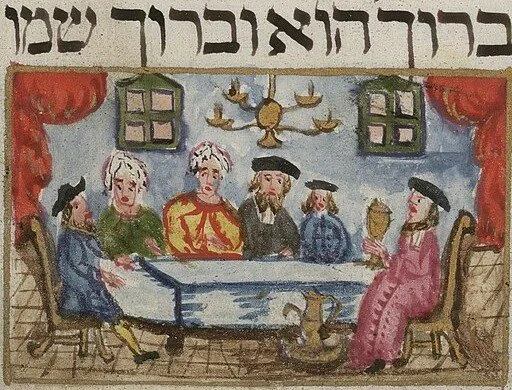
Our parasha includes a famous passage: “So you will eat and be full, and you will bless Adonai your God for the good land He has given you” (Deuteronomy 8:10). This verse displays a specific order: we are commanded to eat first, then be satisfied, and then bless the Lord for all the good land, Eretz Yisrael, He has bestowed upon us. Because of this sequence, our sages introduced a set order for prayer after the meal. This is where the Birkat HaMazon (Grace after Meals) comes into play.
The Birkat HaMazon thanks God for all the provision He has given. It is not just for the food on the table, but includes beautiful details of the Land, the rebuilding of the Temple, and the ultimate reign of King Messiah. When recited in full, it can take twenty minutes or so. Many congregations will take on at least the first blessing, which says:
Praised are You, O Lord our God, Ruler of the universe, who feeds the whole world with goodness, with grace, with lovingkindness and mercy; God gives food to all creatures, for God’s mercy is everlasting. Through God’s abundant goodness we have never yet been in want; may we never be in want of sustenance for the sake of God’s great name. God nourishes and sustains all beings and does good to all, and provides food for all the creatures whom God has created. Praised are You, O Lord, who provides food for all. (Translation: Sefaria.org)
Birkat HaMazon and the Apostles
Did the followers of Yeshua interact with the Grace after Meals? According to the Didache, a second-century collection of sayings of the Apostles, they recited something like it after they ate. Didache Chapter 10 states, “But after you are filled, thus give thanks.” The blessing includes the following, “You gave food and drink to men for enjoyment, that they might give thanks to You; but to us You freely gave spiritual food and drink and life eternal through Your Servant.” Consistent with the Torah, the early followers of Yeshua obeyed this commandment.
Paul also interacts with some form of Birkat HaMazon as he tells the Corinthians,
You cannot drink the cup of the Lord and the cup of demons. You cannot partake of the table of the Lord and the table of demons. . . . If I partake with thankfulness, why am I denounced because of something I give thanks for? Therefore, whether you eat or drink or whatever you do, do all to the glory of God.” (1 Corinthians 10:21, 30–31)
This full chapter discusses the centrality of table fellowship. Do not eat, or give thanks, with bad company. Rather, treat the table as a holy altar. Be thankful. Be faithful to the Lord even with eating and drinking.
Gratitude Until the End
Our haftarah reading is the second of seven Haftarot of Consolation. After the tragic day of Tisha B’Av, when we remember both Temples falling and numerous atrocities that struck our people, these readings are meant to provide consolation and healing to Israel. Our portion this week ends with these verses:
“Listen to Me, you who pursue justice,
you who seek Adonai.
Look to the rock from which you were hewn,
and to the quarry from which you were dug.
Look to Abraham your father
and to Sarah who bore you.
For when I called him, he was but one,
then I blessed him and multiplied him.” For Adonai will comfort Zion.
He will comfort all her waste places.
He will make her wilderness like Eden,
her desert like the garden of Adonai.
Joy and gladness will be found in her,
thanksgiving and a sound of melody. (Isaiah 51:1-3)
We see again God’s deep desire to bless His people through Abraham. The covenant established through Abraham’s seed is unbreakable. We also see that Zion will be redeemed at the end of days filled with joy, gladness, melody, and thanksgiving. Even in Isaiah’s vision of a restored Jerusalem, we will be giving thanks to God for all that He has provided.
Thankfulness is the Thing
According to neuroscientist Dr. Caroline Leaf, we make around 35,000 decisions each day. Some of these decisions are automatically made through cultivated habits. Others are made to reduce decision fatigue (the fear of too many choices). Still others can be learned and ingrained by a fascinating quality called neuroplasticity. This function allows the brain to change and adapt to new circumstances.
Being grateful for what we have is an everyday choice we must make. Will we acknowledge HaShem for all the blessings He gives us? Or will we boast in ourselves, rejecting his good council?
Let us remember the good the Lord has done for our ancestors and the Good News of shalom and joy Messiah Yeshua has brought us. Let us always give thanks to the One who is worth thanking.
Nodeh Lecha—We thank you!
All Scripture references are from the Tree of Life Version, TLV.