

Torah Commentary
Obedience Begins with Listening
“Shema” means to hear or listen, but ancient Hebrew is a language of action. Hearing and listening are passive activities. When we find the word “shema” in the Bible, it can mean “to hear,” but oftentimes it is translated as “listen” when there is an active component of obedience or some form of action attached to the meaning.

Shavuot 5786, Exodus 19:1-20:23
Jennifer Caracelo, Kol Mashiach Messianic Synagogue, Melbourne, FL
Did you know that Hebrew is the only ancient language to be “revived” for modern use? I say “revived” in quotes because Hebrew never went completely dormant. It was always in use for religious purposes but for almost two thousand years it was not used for everyday language. Eliezer Ben-Yehuda believed that the Jewish people needed to unite under a common spoken language and he worked to bring Hebrew back into everyday use. His son, Itamar, was the first native Hebrew speaker in two millennia. Ben-Yehuda undertook the task of adding words for modern things and concepts to the ancient Hebrew language. One new word that was added was a verb for “obey.” In ancient Hebrew, sometimes referred to as “biblical Hebrew,” the word that is translated as “obey” is שׁמע shema. Most of you recognize this word from the beginning of the central creed of Judaism:
שׁמע ישׂראל יי אלהינוּ יי אחד
Shema Yisrael, Adonai Eloheinu, Adonai echad.
Hear, O Israel: The Lord our God, the Lord is one. Deut 6:4
“Shema” means to hear or listen, but ancient Hebrew is a language of action. Hearing and listening are passive activities. When we find the word “shema” in the Bible, it can mean “to hear,” but oftentimes it is translated as “listen” when there is an active component of obedience or some form of action attached to the meaning.
Our Shavuot parashah opens with the preparation of the people before Hashem gives them the Torah on Mt. Sinai. He instructs them:
Now therefore, if you will indeed obey my voice and keep my covenant, you shall be my treasured possession among all peoples, for all the earth is mine. Exod 19:5
In this verse we see the word “obey” is a translation of “shema.” The children of Israel were called to listen carefully to the words that Hashem was about to give to them from Mt. Sinai and to follow through with obedience. Hashem desired for the obedience of Israel to flow from a faith that actively listened to his voice.
Many believe that obedience means following the set of “do’s” and “don’ts” found in Torah, but the sages say that the intention with which we do or do not do things matters. The heart and mind are an active part of obedience. You could say that it is a full-body experience – beginning with our brain as it listens intently and gauges the will of Hashem and moving to our mouths, hands, and feet as they fulfill the mitzvah, while being connected to a heart that is aware of the action it is purposefully engaging in. Torah is a framework for obedience, but the way that we obey his voice requires every aspect of who we are to be engaged in the process.
The phrase “obey my voice” that we see in Exodus 19:5 is found many times in the Tanakh. Hashem calls people to this fully engaged level of response to his word. Referring to the Mount Sinai experience, Hashem reminded the people of the most important part of their covenant with him:
For in the day that I brought them out of the land of Egypt, I did not speak to your fathers or command them concerning burnt offerings and sacrifices. But this command I gave them: “Obey my voice, and I will be your God, and you shall be my people. And walk in all the way that I command you, that it may be well with you.” Jer 7:22-23
Not only does Jeremiah mention the obedience of listening combined with doing, but he adds, “walk in all the way” – another action of obedience. How we direct our steps should be ordered by the voice of Hashem (Prov 16:9).
At Mount Sinai, the voice of Hashem was evident in a clear and powerful way as it came out of the midst of the fire that blazed on the mountain. Though it is not often highlighted in our observance of Shavuot, the fire at Sinai is a key part of the whole experience – so much so that Moses reminds the people of it seven times in Deuteronomy 4 and 5.
The Lord spoke with you face to face at the mountain, out of the midst of the fire. Deut 4:12
This paradigm of Hashem speaking from fire shouldn’t come as a surprise. Before Moses led the people out of Egypt, he was directed to his calling by the voice of Hashem speaking to him from within a bush (Exod 3:4) that was in flames but not burning (Exod 3:2). In fact, the psalmist says this: “The voice of Adonai flashes fiery flames” (Psa 29:7 CJB).
Fast-forward about 1500 years from the giving of the Torah on Mount Sinai to the Shavuot following Yeshua’s death, resurrection, and ascension.
When the day of Shavuot had come, they were all together in one place. Suddenly there came from heaven a sound like a mighty rushing wind, and it filled the whole house where they were sitting. And tongues like fire spreading out appeared to them and settled on each one of them. They were all filled with the Ruach ha-Kodesh and began to speak in other tongues as the Ruach enabled them to speak out. Now Jewish people were staying in Jerusalem, devout men from every nation under heaven. And when this sound came, the crowd gathered. They were bewildered, because each was hearing them speaking in his own language. Acts 2:1-6 TLV
The Acts narrative also mentions fire. Not the benign little flames that get depicted peacefully resting atop everyone’s head, but most likely the fiery flames that the psalmist speaks of. These tongues of fire allowed the disciples to speak in the languages of all the nations that were assembled there. If we consider the words of Psalm 29:7, these tongues of fire were more than just fire. They were the very voice of Hashem alighting on the people and giving them the ability to speak his words to the nations.
We know this Acts 2 experience at Shavuot as “the giving of the Ruach Hakodesh.” When we look at the imagery of what happened, we could call this the giving of the Voice of Hashem to the followers of Yeshua. No longer do we need to wait for a once-in-a-millennium experience in which literal flames come from heaven to speak to us. We now have the ability to hear the Voice of Hashem on a daily, even minute by minute, basis. How privileged we are that we can more easily obey his voice as he has called us to do!
Yeshua left his disciples with these words:
But the Counselor, the Ruach HaKodesh, whom the Father will send in my name, will teach you everything; that is, he will remind you of everything I have said to you. John 14:26 CJB
In other words, the Ruach HaKodesh will be the Voice of Hashem within you. Today, let us resolve to listen – shema – with minds attuned to the words of the Ruach Hakodesh within us and hearts prepared to align our lives to Hashem’s will. Let us use our mouths to speak words of love, kindness, and encouragement. Let our feet be always quick to go where he directs us and our hands eager to do his work as we obey his voice.
All verses are taken from the ESV, except where noted.
An Invitation to Intimacy
God is not just a God of order; he desires for us to draw near to him. As we begin the Book of Numbers, we remember how he cared for our ancestors by numbering them and giving them freedom from bondage. Further, he invites them into intimacy, into a covenant that is alive and well today. Our challenge is: Will we accept it?

Parashat Bamidbar, Numbers 1:1–4:20
Joe Miterko, Kol Mashiach, Melbourne, FL
Adonai spoke to Moshe in the Sinai Desert, in the tent of meeting, on the first day of the second month of the second year after they had left the land of Egypt. He said, “Take a census of the entire assembly of the people of Isra’el, by clans and families. Record the names of all the men twenty years old and over who are subject to military service in Isra’el. You and Aharon are to enumerate them company by company.” (Numbers 1:1–3)
A Special Season
This time of year is so exciting for us. Summer is on its way with its joys and frivolities; we begin a new book in our Torah cycle; and Shavuot is approaching next week. I always look forward to Shavuot. As a kid, one of my favorite traditions was our dessert oneg with Mount Sinai Sundaes & Moishemallows! That was way more exciting than matzo and maror, as matzo can make me bored and is pretty crumby.
All jokes aside, the afterglow of Pesach seems distant at this point, yet we remember our wanderings between redemption from Egypt and revelation at Sinai. We are commanded to keep a simple act of obedience for this time: we count the Omer! Moreover, we make these days of Omer count as we prepare ourselves to receive the gifts of the Torah and Ruach all over again, renewing our commitment to God’s Word. He desires us to order our days so we can see his work in our lives.
Order and Shalom
Hashem loves and desires order. Paul writes “For God is not a God of unruliness but of shalom. . . . Let all things be done in a proper and orderly way” (1 Cor 14:33, 40). In the Torah, we see God’s order dispel chaos (see Gen 1:2) and then we see creation blossoming thereafter. Vayikra took us on a journey of instruction about holiness and proper worship. Priests, purity, holiness, and everyday matters were discussed at length within its chapters. These newly freed people needed to learn what true worship, avodah, looked like. Moreover, they needed to free themselves from a mindset of slavery. We even see the consequences of those who break this order of worship: Aaron’s two sons, Nadav and Avihu, were consumed for not following Hashem wholeheartedly (Lev 10).
A People of Order and Shalom
Now we come to our parasha, Bamidbar. Bnei-Yisrael are set to leave Mount Sinai, ready for their next leg of the journey towards the Land of Promise. After all, it has been two years since leaving slavery in Egypt. Before the people can move, Hashem instructs Moshe and Aharon to number them. Specifically, he directs that all the men twenty years and older be counted for military service. The rest of our text this week describes this census, the formation of the tribes, and the unique roles and responsibilities of the Levites.
At first glance, this parasha seems mundane and uneventful. Yet this is such an exciting part of the journey for Bnei-Yisrael.! Hashem takes a people who are scattered, still shaking off the chains and dust of Egyptian oppression, and creates a people for himself. The same God who ordered each day of creation is making sure his people are accounted for. Indeed, Rabbi Lord Jonathan Sacks comments, “It is almost as if the Torah were describing the Israelites the way it describes the cosmos in the first chapter of Genesis, everything in its due proportion and proper place.” Not only is this an important step towards unity of the Jewish people; it also shows that Hashem cares for every single individual within the camp.
A Call to Intimacy
This call to enumerate the people goes beyond checking off boxes and creating physical order. Hashem invites his people into a covenantal relationship through intimacy. He wants each person standing at Sinai to know that they are beloved, cared for, and treasured by him. Even when times get tough, even when the wilderness seems endless without food, water, and shelter, the people are invited to know that Hashem’s arm is continuously fighting for them. `
The text of our Haftarah passage in Hosea dives more deeply into this concept. It opens:
Nevertheless, the people of Isra’el will number as many as the grains of sand by the sea, which cannot be measured or counted; so that the time will come when, instead of being told, “You are not my people,” it will be said to them, “You are the children of the living God.” (Hos 2:1 [1:10])
Later on, the Lord makes a beautiful promise:
I will betroth you to me forever; yes, I will betroth you to me in righteousness, in justice, in grace and in compassion; I will betroth you to me in faithfulness, and you will know Adonai. (Hos 2:21–22 [2:19–20])
The people being as numerous as the grains of sand by the sea harkens back to the census taken at Sinai. Further, the Lord draws them into a relationship as a groom with a bride. This concept of betrothal is critical to the Biblical narrative. In fact, on Pesach we read Song of Songs to remember this.
Recommitment through Intimacy
In the New Testament, we read how the resurrected Yeshua would appear to his talmidim during the days of the Omer. In fact, Rav Sha’ul said he appeared to over five hundred people (1 Cor 15:6). Yet, he revealed himself in a more intimate way to some of his followers. John 21 highlights an episode of particular interest. We see a close dialogue between Yeshua and Peter, even after Peter’s bitter denial from a few nights beforehand. Yeshua wants his love to restore Peter and meet him where he is. After they ate breakfast that the Master prepared on the shores of the Galil, he took time to have a very important conversation that Peter needed to hear.
God is not just a God of order; he desires for us to draw near to him. As we begin Sefer Bamidbar, we remember how he cared for our ancestors by numbering them and giving them freedom from bondage. Further, he invites them into intimacy, into a covenant that is alive and well today. Our challenge is: Will we accept it? Will we draw close as God desires to know us even more deeply? Will we love this beautiful heritage he has given us? My answer is a hearty Ken y’hi ratzon—Yes, may it be your will!
Shabbat Shalom!
All Scripture references are from Complete Jewish Bible (CJB).
Real Trust Requires Surrender
What is surrender? Simply put, it is giving up our idea of how our lives should be run and accepting God’s idea for us. As he lays out his direction for our lives, we display that Abraham-like trust.
Parashat Behar-Bechukotai, Leviticus 25:1–27:34
Rabbi Jude Caracelo, Kol Mashiach, Melbourne, FL
Behar-Bechukotai is another double Torah portion, and the last two parashot in the book of Leviticus. We are right in the middle of the Torah, and these portions have a significant amount of rules and laws that the Israelites had to take on and follow as part of their covenant with Hashem. There are laws about redemption of property, redemption of a fellow Israelite brother, regulations on vows, and even rules for how to treat others with kindness. Hashem was teaching the Israelites the right way to live life – his way. Sometimes this could mean they were told to do things that just didn’t make sense to them. And that required that they trust God and surrender to his will for their lives. And the same is true for us today. We, as followers of Yeshua, are called to a life of trust & surrender to the Lord’s plan for our lives.
The double portion begins with the shemita, the sabbatical year:
The Lord spoke to Moses on Mount Sinai, saying, “Speak to the people of Israel and say to them, When you come into the land that I give you, the land shall keep a Sabbath to the Lord. For six years you shall sow your field, and for six years you shall prune your vineyard and gather in its fruits, but in the seventh year there shall be a Sabbath of solemn rest for the land, a Sabbath to the Lord. You shall not sow your field or prune your vineyard. You shall not reap what grows of itself in your harvest, or gather the grapes of your undressed vine. It shall be a year of solemn rest for the land.” (Leviticus 25:1–5)
The Children of Israel were subsistence farmers, so they had to sow and reap their fields to survive. If you didn’t work, you didn’t eat. You could not provide for your family. Can you imagine what they may have said when they heard these words from Hashem? “What do you mean we can’t work our fields for a whole year? That doesn’t make any sense. We won’t survive!” I can certainly imagine this, because this is what I most likely would say. But what this statute, and this double Torah portion teaches us, is that frequently the Lord has us do things that just don’t make sense to us. This requires us to trust him. Trust is defined as a reliance on the integrity, strength or ability of someone or something. In this case, the Israelites had to rely on God and trust that he would make the right decisions for them. They had to allow him to direct their lives.
We can see this pattern of trusting God even when it doesn’t make sense with other people in the Bible. One such character was Abraham. He trusted Hashem when he was called from his home country and his people and told to go to a new land he didn’t know. He trusted Hashem when the Lord promised Abraham a son, even though his wife Sarah was barren and could not have children. And he still trusted God, when he was told to then take the son he had long been promised and sacrifice him on an altar to the Lord.
After these things God tested Abraham and said to him, “Abraham!” And he said, “Here I am.” He said, “Take your son, your only son Isaac, whom you love, and go to the land of Moriah, and offer him there as a burnt offering on one of the mountains of which I shall tell you.” (Genesis 22:1–2)
What was Abraham’s response to this request from the Lord? The Biblical text goes on to tell us that Abraham rose up early the next morning and set out with Isaac to the place of sacrifice. In obedience, Abraham trusted God and acknowledged him as sovereign over his life. Would we have that type of trust? Or would we argue with the Lord? If I’m honest, and the Lord asked this of me, I could hear myself probably having a nice Jewish discussion with him about it. “Lord, can’t you see I have trusted you already so much in my life? I need a break here! Why does no one else have to sacrifice their son but me? Listen, I’ll do anything else. Please just let me keep my son!”
Of course, Abraham didn’t say this. He went forward and was about to sacrifice Isaac when God intervened at the last second. In this instance and in many others, Abraham demonstrated a consistent pattern of reliance on God and not himself. Like Abraham, we are asked to trust God with our lives over and over. Trust is not just giving God the reins once in our life, and expecting a “well done, good and faithful servant” in the end. This type of repeated trust is demonstrated by us surrendering our lives to him. What is surrender? Simply put, it is giving up our idea of how our lives should be run and accepting God’s idea for us. As he lays out his direction for our lives, we display that Abraham-like trust.
Looking back at our parashah in particular, and the entire Torah in general, we see Israel being called to surrender everything to God. This meant in all aspects of their lives, and it included their idea of how life should go. They were called to do everything God’s way and not their way. That can seem easy for us when God asks us to do something we understand. But it is required even when we don’t. And frequently we don’t understand! We are called to surrender our lives to God. Yeshua our Messiah said, “Whoever finds his life will lose it, and whoever loses his life for my sake will find it” (Matthew 10:39).
King Solomon once wrote, “What has been is what will be, and what has been done is what will be done, and there is nothing new under the sun” (Ecclesiastes 1:9). The Israelites had to learn to trust God and surrender to him when he asked them to take a sabbatical year every seventh year. Abraham had to trust God and surrender to him when God told him to kill his long-awaited son. And as followers of Yeshua, each one of us is to trust God and surrender to him with whatever he calls us to in our lives. Even when it doesn’t make sense.
Scripture references are from the English Standard Version (ESV).
The Shepherd and the Lamb
The offering and Priest — the Shepherd and the Lamb
Glory to the One who died and rose again
And is the great I Am
The Shepherd and the Lamb
Hallelujah!

Parashat Emor, Leviticus 21:1-24:23; Haftarah, Ezekiel 44:15-31
Rabbi David Wein, Tikvat Israel, Richmond, VA
You are not obligated to finish the work,
But neither can you refrain; so don’t just sit there and lurk.
That’s from “The Sayings of the Fathers” or Pirke Avot
And 2:16 is where I got that quote.
Now in Ezekiel 1, in the thirtieth year
(“But of what?” we may ask — perhaps birthday cheer)
So it’s Ezekiel, perhaps, that is turning 3-0.
In which case, that’s the year that a priest starts the show!
But he can’t, there’s no Temple, it’s all been destroyed
So, Ezekiel, the priest, must feel distraught and annoyed
But even if the 30 doesn’t refer to ole’ Zeke
The situation where a priest can’t do his calling is unique.
Now he’s sitting on the bank of the Kebar River
Wondering how the Lord could ever deliver.
If the Temple is gone, whence the Presence of God?
And how could he ever fulfill his priesthood abroad?
By the Rivers of Babylon, where we sat down,
There we wept, when we remembered Zion.
Then the wicked carried us away in captivity
And required from us a song.
But how can we sing the Lord's song
In a strange land?
When suddenly the heavens opened, with strange weather features,
Wind, fire, and lightning, and four living creatures
And a blazing heavenly chariot: the God-mobile,
A movable throne with tricked-out bejeweled wheels
That for some reason in Jerusalem — at that moment — was not found
For the Lord God of Israel cannot be geographically bound.
And Ezekiel may have wondered how his assignment was even knowable
But God’s gift and his calling are irrevocable.
We may say this to God as well: “How can I do it?
“I’m ill-equipped, incomplete, and I already blew it.
“Plus the forces around me are beyond my control,
I’m bruised and I’m broken — just a weary soul.”
And in this week’s parasha, something lingers like mist:
The incomplete priests are apparently dismissed.
He cannot be blind, or disfigured, or lame
In the Holy Place — this desecrates the Name.
He cannot have scars or boils or scurvy
Or be missing a limb or be from New Jersey
(Not because something’s wrong with the great Garden State
But because he’d be anachronistic — 3000 years late).
But here is the catch — he’s not put out to pasture
He can still eat the holy food — not a total disaster.
He can pray, lead, and guide — gather wood for the altar.
He can judge, teach, and worship, and sing from the psalter.
He can worship God with the Levites orally.
He’s unclean ritually, but for sure not morally.
Remember ole’ Zeke — well he’s not just a priest
But one of the greatest prophets to come out of the East.
You’re not defined by one thing that you do
You’re a complex, integrated, and valuable you!
Our defects are setbacks, but they’re not who we are.
They throw a wrench in our calling, but can’t totally bar
And even if circumstance brings you outside the Land
And the Temple’s gone — nonetheless, God has a plan!
Perhaps he will bring his Presence right to your spot
To comfort and guide you, ‘cause he likes you a lot.
Now, the story doesn’t end with limitation;
The Gospels show a move toward wholeness and restoration
For Yeshua heals the blind, the sick, and the lame,
And what he did years ago, he still does the same.
So if you have a defect, a blemish, or blight,
It might be a weakness to accept until all things are made right,
Or a skill to develop, to learn over time,
Or a job to delegate, like the seeing priests did for the blind,
Or perhaps a change in belief is rising to the surface
Like you think you can’t do something just because you’re not perfect.
We are not required to complete God’s work on the earth
But neither can we refrain because we doubt our inherent worth
‘Cause we are made in his image, loved more than words can express.
He’s not looking for perfection — he’s looking for a “yes.”
And if you’re wondering why this drash was done in coupled rhyme
Perhaps I’m full of whimsy, or just have too much time
Or perhaps I wanted to share, in ordered pairs,
How God makes things whole, restores, and repairs.
Plus, I wanted to show through conventional poetry
How God brings life and order — from wasteland to “grow-a-tree.”
But there’s another pairing besides these rhyming couples
It’s in the parasha this week, there’s a purposeful double:
The sacrifice and the priest have the same laws and stipulations,
They both must be whole and unblemished creations.
There is One who exists without any defect in the least
Both the perfect, final sacrifice and eternal High Priest.
The offering and Priest — the Shepherd and the Lamb
The offering and Priest — the Shepherd and the Lamb.
Glory to the One who died and rose again
And is the great I Am.
The Shepherd and the Lamb.
Hallelujah!
Yeshua went from whole to broken, to make the broken whole. Yeshua absorbed uncleanness, sin, and death into himself, to bring cleansing, forgiveness, and eternal life.
Therefore if anyone is in Messiah, this person is a new creation; the old things have passed away; behold, new things have come. He made him who knew no sin to be sin on our behalf, so that we might become the righteousness of God in him. (2 Cor 5:17,21)
Real-life Holiness
Holiness means being set apart, but not just from something. It means being set apart to Someone. That’s the difference. If holiness is only separation, you end up with legalism. If it’s only connection, you end up with compromise. Torah holds both together.

Acharei Mot-Kedoshim, Leviticus 16:1–20:27
David Tokajer, Congregation Mayim Chayim, Daphne, AL
Parashat Acharei Mot–Kedoshim sits right within the tension every serious believer has to deal with: we want closeness with God, but we don’t get to define the terms of that closeness. Leviticus 16 opens with the death of Nadav and Avihu in chapter 10 still hanging in the air. This is not just background, it is a warning label: You don’t walk casually into the presence of a holy God.
The instructions for Yom Kippur are then laid out in detail. One day. One man. One way. The Kohen HaGadol enters the Holy of Holies not with creativity, not with personal expression, but with precise obedience. Blood is brought in, not as a ritual for ritual’s sake, but as a stark reminder: access to God costs something. Sin is not theoretical; it stains, it separates, and it requires atonement.
But then we come to chapter 17, and the focus shifts. Suddenly it’s not just about the High Priest once a year, it’s about every Israelite, every day: What you eat; where you bring sacrifices; and how you treat blood. Holiness is no longer confined to the Mishkan, it starts pressing into the ordinary rhythms of life.
Then the transition from macro to micro continues with chapters 18 and 20 of Leviticus, areas most people would rather skip. Sexual ethics. Boundaries. Prohibitions that feel blunt and, to modern ears, uncomfortable. But here’s the point: holiness is not abstract. It shows up in the most personal areas of life. God is not just interested in your worship set or your prayer language. He’s concerned with your body, your relationships, your integrity when no one is watching.
Then comes Leviticus 19, the center of Parashat Kedoshim, and it hits like a hammer: “You shall be holy, for I, Adonai your God, am holy” (Lev 19:2 TLV). This not a suggestion or some sort of spiritual bonus tier. It’s the baseline expectation of covenant life.
But look at how that holiness is defined. It’s not mystical detachment, nor is it retreating from the world into isolation. It’s deeply practical:
• Leave the corners of your field for the poor.
• Don’t steal.
• Don’t lie.
• Pay your workers on time.
• Don’t curse the deaf or trip the blind.
• Judge fairly.
• Don’t gossip.
• Love your neighbor as yourself.
This is where people far too often get it wrong. Holiness is not about appearing spiritual; it’s really about reflecting God’s character in real, lived ways. It is ethical, relational, and visible.
The rabbis picked up on this tension. In Sifra Kedoshim, the command to “be holy” is tied directly to separation from immoral behavior, not as an end in itself, but as alignment with God’s nature. Ramban pushes it further, warning against being a נבל ברשות התורה (naval birshut haTorah), a scoundrel within the bounds of the Torah. In other words, you can technically keep commandments and still completely miss holiness if your heart and conduct are corrupt. Holiness is not loophole management, it’s transformation.
Now here’s where this lands for us in a Messianic Jewish context. We don’t read Acharei Mot without thinking about Yeshua. Hebrews 9–10 makes the connection unavoidable. The High Priest entering once a year with blood is a ritual that pointed forward. Yeshua doesn’t enter an earthly Holy of Holies; He enters the heavenly one, once for all, with His own blood.
This reality changes access. It doesn’t lower the bar of holiness, it actually raises it. Because now the question isn’t, “Can I come near God?” The answer is yes, through Messiah. The real question becomes: “Now that I’ve been brought near, how do I live?”
Peter quotes Leviticus directly: “For it is written, ‘Kedoshim you shall be, for I am kadosh’” (1 Peter 1:16 TLV). He doesn’t water it down, he doesn’t reinterpret it into something symbolic. He doubles down. Why? Because holiness was never about geography, it was always about identity. You are either reflecting God’s character, or you’re not.
And this is where Acharei Mot–Kedoshim cuts through modern spirituality.
We live in a culture that wants intimacy with God without transformation. People want presence without obedience. We want the experience of God without the standards of God. That doesn’t exist in Tanakh, and it doesn’t exist in the Brit Chadashah either.
Holiness means being set apart, but not just from something. It means being set apart to Someone. That’s the difference. If holiness is only separation, you end up with legalism. If it’s only connection, you end up with compromise. Torah holds both together: you are separated from what is corrupt so that you can be fully aligned with the One who is holy. And that plays out in everything:
• Holiness in your speech: no gossip, no deception.
• Holiness in your business: fairness, integrity.
• Holiness in your relationships: faithfulness, boundaries.
• Holiness in your worship: reverence, not casual familiarity.
• It’s comprehensive. It touches every inch of life.
Leviticus 20 closes out the parasha by repeating the same idea in a slightly different form: “You are to be holy to Me, for I, Adonai, am holy, and have set you apart from the peoples, so that you would be Mine” (Lev 20:26 TLV).
That is covenant language. Ownership language. Identity language. You don’t pursue holiness to become God’s people. You pursue holiness because you already are His.
So here’s the reality: holiness is not optional for the believer. It’s not extreme. It’s not reserved for the “super spiritual.” It is the expected outcome of walking in covenant with a holy God. And if we’re honest, this is where the struggle is. Not in understanding holiness, but in actually living it out consistently. Because holiness will always confront areas we’d rather leave alone.
But that’s exactly the point. God doesn’t call us to selective holiness. He calls us to comprehensive holiness, because He is comprehensively holy. So the question Acharei Mot–Kedoshim forces on us is simple and uncomfortable: Where in my life am I trying to draw near to God without actually aligning with His holiness?
Because Torah doesn’t allow that disconnect, and neither does Messiah. Holiness is not the barrier to intimacy with God. It is the pathway.
The Lightness of Grace
When grace is received, it often feels like a lifting, a release from heaviness long carried. Something shifts within, as though the gravity of the soul has changed. The rabbinic tradition gives language to this transformation. “Great is repentance, for it can transform even deliberate sins into merits” (Yoma 86b). What once weighed us down can, through grace, become the very ground of renewal.

Parashat Tazria-Metzora, Leviticus 12:1-15:33
Rabbi Paul L. Saal, Shuvah Yisrael, West Hartford, CT
Seeing the Whole Person
In this week’s Torah portion, Tazria-Metzora, we encounter the person afflicted with tzara’at, a skin condition that brings not only physical suffering but also deep social isolation. The Torah instructs that the afflicted individual be brought to the Kohen for examination, and then later for re-examination. The repetition invites a deeper question. What, exactly, is the Kohen meant to see?
Already, the tradition pushes us beyond a surface reading. The halakhic midrash teaches that the priest must examine not only the affliction but also the person himself (Sifra, Tazria, Parashah 5). The Kohen is not simply diagnosing a condition. He is encountering a human being.
Rabbi Yehoshua of Kutno deepens this insight, teaching that the Kohen must see the whole person, not merely the outward affliction. This requires a kind of spiritual imagination, the ability to look beyond visible brokenness and perceive the wholeness that still resides within. The Kohen’s role is not merely diagnostic but restorative. Healing begins with seeing rightly.
And this calling is not limited to the Kohanim of old. It is a calling that rests upon all of us.
The Power to Transform
In the Besora of Luke, chapter 14, verses 1 through 6, Yeshua encounters a man on Shabbat suffering from a debilitating condition at the house of a Pharisee. The man is clearly in need, yet those present, who might have had the authority or ability to respond, remain distant. They choose caution over compassion and judgment over healing.
The tradition itself warns against such distance. “Judge every person on the side of merit” (Pirkei Avot 1:6). To see only the fault is to fail in our moral vision.
Yeshua responds differently. He heals the man, and in doing so reveals something essential about the nature of the Kingdom of God. It is not a realm of exclusion but of radical inclusion, a table widened by grace, where even the unexpected and the unwanted are invited in. After all, to restore even one life is to restore an entire world (Sanhedrin 37a).
This same dynamic appears when two blind men cry out to Him, “Have mercy on us, Son of David.” Yeshua does not assume what they need. Instead, He asks, “What do you want Me to do for you?” It is a deeply personal question, one that honors their agency.
That question continues to echo. Grace is offered freely, but it is not imposed. It invites response.
The Courage to Be Healed
This raises a more difficult truth: Not everyone truly wants to be healed.
In the Gospel of John, chapter 5, Yeshua approaches a man who has been lying near the pool of Bethesda for thirty-eight years and asks him, “Do you want to be healed?” At first glance, the question seems unnecessary. Of course he wants healing. Or perhaps not.
The sages remind us that transformation often requires help beyond ourselves. “A prisoner cannot free himself from prison” (Berakhot 5b). Healing demands not only the possibility of change but the willingness to step into it.
Healing is not only about relief. It is about transformation. It requires letting go of familiar patterns, even when those patterns are painful. It asks us to release identities we have grown accustomed to, even when those identities are shaped by brokenness. To be healed is to risk hope.
There are times when people become so accustomed to the weight they carry that they no longer imagine life without it. They stop seeing themselves as whole. They stop believing that change is possible. And yet grace cannot take root in a heart that is closed to it. It must be received.
The Lightness of Grace
When grace is received, it often feels like a lifting, a release from heaviness long carried. Something shifts within, as though the gravity of the soul has changed.
The rabbinic tradition gives language to this transformation. “Great is repentance, for it can transform even deliberate sins into merits” (Yoma 86b). What once weighed us down can, through grace, become the very ground of renewal.
Grace works in multiple dimensions of our lives. It lifts the burden of guilt by reminding us that we are forgiven. It heals the wound of shame by affirming that we are loved. It strengthens us to change by assuring us that we are capable. And it fills us with gratitude, awakening a sense that we are, indeed, blessed.
A powerful illustration of this transformative grace can be found in the story of Larry Trapp, a former white supremacist who terrorized Jewish communities and people of color. He once sent death threats to Cantor Michael Weisser, filled with hatred and menace.
Yet Cantor Weisser responded not with fear or retaliation, but with unexpected kindness. He reached out, left messages of peace, and eventually made contact. Over time, something in Trapp began to break open. He repented. He wept. He allowed himself to be seen differently and to see differently. Before his death, he even embraced Judaism.
Grace did not deny the harm that had been done. But it refused to define the man solely by his worst actions. It saw beyond them toward the possibility of transformation. It saw wholeness before he could see it himself. As the midrash reminds us, the Holy One desires the heart (Midrash Tehillim on Psalm 34).
Rising to the Occasion
To be healed, we must learn to see ourselves as whole, even when we feel broken.
To bring healing to others, we must learn to see them as whole, even when their brokenness is all too visible.
This is what it means to live as a mamlechet kohanim, a kingdom of priests. We are called not to stand at a distance in judgment but to draw near in compassion. We are called to recognize the image of God in the face of the afflicted, to speak words that restore, and to embody the lightness of grace.
The invitation before us is both simple and profound.
To rise to the occasion.
To become healers.
To live as whole people.
And, in doing so, to become vessels of grace.
Beauty in Distinction
Our sages recognized the importance of distinction and taught us to bless the “One who makes creatures different,” affirming that diversity itself is part of the Divine wisdom. Each person, each animal, each role, reflects a different facet of God’s glory. When these distinctions are honored within a framework of love and covenant, they do not divide us—they deepen our capacity to see one another and to see God more fully.

Parashat Shemini, Leviticus 9:1–11:47
Matthew Absolon, Beth Tfilah, Miramar, FL
This week’s portion, Shemini, presents us with a foundational charge at the heart of Torah life: “You are to distinguish between the holy and the common, between the unclean and the clean, and you are to teach the people of Israel all the statutes that the LORD has spoken to them by Moses” (Leviticus 10:10–11).
This imperative is not confined to the ritual sphere alone; rather, it reflects a broader theological and moral discipline. The life shaped by Torah is at its core a life cultivated in distinction.
Indeed, the very fabric of creation is woven through acts of distinction. “God separated the light from the darkness” (Genesis 1:4). The word “separated” shares the root of the word translated as distinction (בדל). It’s from this same root that we get the word “Havdalah,” meaning “to make distinct/ separate.”
Through the creation story we see that prior to comprehension, there is order; prior to beauty, there is separation. Distinction, therefore, ought not to be misconstrued as division, but rightly understood as the necessary condition for harmony. Distinctions, properly held, do not diminish creation—they allow it to flourish, each part bearing its own dignity and purpose.
This insight finds an unexpected parallel in the contemporary field of artificial intelligence. Despite considerable advancement, AI continues to struggle with even the most basic acts of perception; failing to distinguish reliably between a hand and its fingers, or between sky and cloud. Without careful instruction, the world appears to AI as without form and void of meaning.
And if we are honest, we may recognize something of ourselves here. Without the steady guidance of the Torah, the human heart, too, begins to blur what God has made distinct.
Where such distinctions erode, confusion inevitably follows. The categories of light and darkness, holy and common, clean and unclean become increasingly indistinct. When a society relinquishes these boundaries, it does not enter into a realm of greater freedom, but rather into one of deep disorientation.
Nature abhors a vacuum; where the virtue of distinction recedes, the vice of chaos is seldom far behind, waiting to fill the vacuum.
Yet it must be said with equal care that the distinctions articulated by the Torah are never intended to wound or exclude. Although further on the Lord tells Israel, “I have set you apart . . . to be Mine” (Leviticus 20:26), yet the prophet Isaiah tenderly reminds us, “Let not the foreigner say, ‘The Lord will exclude me’” (Isaiah 56:3). Here we encounter the sacred tension between the particular and the universal; a tension that can only be resolved through the covenantal work of Yeshua and his love filling our hearts.
Our sages recognized the importance of distinction and taught us to bless the “One who makes creatures different” (meshaneh ha-briyot), affirming that diversity itself is part of the Divine wisdom. Each distinction carries within it a unique dignity. Each person, each animal, each role, reflects a different facet of God’s glory. When these distinctions are honored within a framework of love and covenant, they do not divide us—they deepen our capacity to see one another and to see God more fully.
As we learn the correct distinctions as shown to us by the Torah, may we learn to love each other, not in spite of our distinctions, but because of our distinctions. May we see the unique facet of God’s beauty, distinct in the person sitting right next to us.
Shabbat shalom!
Afikomen—A Passover Symbol of Hope
Oy vey! What tumultuous times we are living in! Right when it seems that we hit a new low, there seems to be another one. Whether it be the troubling war in the Middle East, the shaky economy in the USA, or the increasingly ugly presence of antisemitism, there seems to be no shortage of things to worry about. Many people consequently have hit new lows of anxiety and despair. This sounds like the perfect time for a Seder!

Passover 5786
Rabbi Barney Kasdan, UMJC President
Oy vey! What tumultuous times we are living in! Right when it seems that we hit a new low, there seems to be another one. Whether it be the troubling war in the Middle East, the shaky economy in the USA, or the increasingly ugly presence of antisemitism, there seems to be no shortage of things to worry about. Many people consequently have hit new lows of anxiety and despair.
This sounds like the perfect time for a Seder! It is always a blessing to gather with family and friends for this most ancient religious observance among humanity. Alongside the delicious dinner is a Seder plate which displays the important reminders of our redemption from slavery. There’s a shank bone of a lamb, recalling the original sacrifice, as well as the bitter herbs and sweet haroset to remind us of both the bitterness of slavery and the sweetness of freedom. There is also a conspicuous container for three pieces of matzah called the Matzah Tash. The more one contemplates this unusual religious element, the more mysterious it becomes.
We could ask, as we do of the various other elements, “What is the meaning of these three separated matzahs in the one container?” In the traditional Haggadah there is no lengthy explanation for this universal custom although it is certainly a vital element of the Seder. One interpretation is that the three pieces of unleavened bread represent our forefathers; Abraham, Isaac, and Jacob, who are our distinct yet united as one. Another interpretation suggests that perhaps the three matzahs represent the three classes of the Jewish people; Cohen, Levi, and common people of Israel, united is one. While these interpretations are worth considering, there are still more mysterious elements about the Matzah Tash and especially the middle matzah.
Towards the beginning of the Seder, it is the middle matzah which is removed from the Matzah Tash and becomes a special focus of the dinner. Without explanation that middle matzah is broken in half with one half going back into the container while the remaining half becomes a special focus called the Afikomen. This broken matzah is then wrapped up or placed in an afikomen bag and hidden away while all the guests close their eyes. The afikomen will thus remain hidden until the end of the Seder when it makes a surprise return after there is a search for it.
This part of the ceremony leads to more questions. Why the special focus on the middle matzah? Why is Isaac removed and broken? Why would the Levites be hidden away? There are other interpretations that actually make a lot more sense. Rabbi Dr. Ron Wolfson of American Jewish University points out the following:
The step of the Seder where the afikomen is found and redeemed is called Tzafun, literally "hidden." This is a "hiding" which will ultimately be discovered. This is a "hiding" which foreshadows the future. In the future, something now in hiding will make complete that which is now incomplete. This is a foreshadowing of the Messiah, establishing that we not only celebrate the Passover of the past, but the Passover of the future. (The Passover Seder, p. 103)
This interpretation regarding the Messiah resonates with those of us in Messianic Judaism. Messiah is to be broken for our transgressions and buried for a season according to the Tanakh, yet it is predicted that he will also reappear after a short period of time (see Isaiah 53). A careful reading of the New Testament seems to confirm that it was this afikomen that Yeshua shared with his Jewish disciples at that famous last Seder. Although he would be broken at this season, there is great hope, as he would also reappear in resurrection—an event that would change the course of world history to this day. A testimony to this reality is the millions of believers from various tribes and tongues who will be celebrating this resurrection hope during this holiday week, including a significant number of us Jewish Yeshua-followers at our seders.
So, we come to Passover 5786 and the challenges of our current day. We will continue to pray and work for a lasting peace throughout the Middle East. May this Passover be a time of renewal and refreshment with family and friends. May it also be a time of optimism and hope as we contemplate the messianic symbolism of the afikomen. As Yeshua himself affirmed at that last Seder: "In the world you will have tribulation (tzuris) but take heart; I have overcome the world" (Yochanan / John 16:33).
Passover Removes the Leaven of Despair
It may be normal to be anxious as we’re bombarded with reports of antisemitic violence. But the Survivors’ Haggadah (published in 1946 for Jews still in European DP camps observing their first Passover after World War II) declares, “The seder is a protest against despair.”

Photo: Yeast spores, Getty Images
Shabbat Hagadol, 5786
Russ Resnik, UMJC Rabbinic Counsel
In synagogues around the world, the sermon for Shabbat Hagadol (the shabbat before Passover) usually focuses on preparations for the holiday ahead. It will doubtless be the same this year, with Shabbat Hagadol coming March 28, but our preparations may need some expansion amidst the current surge of antisemitism throughout Europe and North America.
Passover, of course, is communal, family-oriented, celebrating the great high point of the Jewish story. But Passover entails a personal dimension as well: “In every generation,” says the Haggadah, “a person ought to look on himself as if he came forth from Egypt.” So, preparations for Passover include outward, familial steps—including the well-known (if not so well-loved) tradition of cleansing the home of all leaven or chametz—as well as inward preparation. Guidelines for our preparation are given in the account of the first Passover in Exodus 12.
14 “This day shall be for you a memorial day and you shall keep it as a feast to the Lord; throughout your generations, as a statute forever, you shall keep it as a feast. . . . 18 In the first month, from the fourteenth day of the month at evening, you shall eat matzot until the twenty-first day of the month at evening. 19 For seven days no leaven is to be found in your houses. . . . 20 You shall eat nothing leavened; in all your dwelling places you shall eat matzah. (ESV modified)
Verses 19–20 reiterate two aspects of the preparation: Negative—remove leaven, chametz, from your homes; and Positive—eat unleavened bread, matzah.
Outward preparation, then, includes the removal of chametz, which includes all products containing the five grains of biblical times: wheat, barley, spelt, rye, and oats. In later times Ashkenazi Jews also came to prohibit kitniyot—including legumes, rice, peanuts, and corn—but Sephardic custom permits these. The ban on chametz traditionally includes ownership: chametz products must be discarded, given away, or sold to a gentile (although it’s permissible to buy them back after Passover).
But why do we focus on removal of grain and grain products when the Torah just bans leaven? Because yeast spores are in the air around us and will alight on any grain that’s present and leaven it. Both the Talmud and the B’rit Chadasha speak of leaven as a metaphor for sin or the “evil inclination,” in a deep insight into the pervasiveness of sin and its corrupting nature. This is where preparations for Passover must be personal and inward, as well as outward and communal. When all the chametz is removed from your possession, it’s customary to recite a nullification: “All chametz in my possession [even if I missed it], may it be annulled and made ownerless, like the dust of the earth.” At some point an additional, more personal annulment was added to the prayer:
Just as I have ridden the chametz from my house and all I possess, may it be pleasing in your sight, Lord our God and God of our Fathers, to rid me of the Evil Inclination, and to rid all wickedness from the land (earth).
So, we don’t eat or even own chametz, but we do eat matzah, “the bread of affliction [or humility],” which reminds us that we were once afflicted by sin and death, and only God in his mercy could set us free. Just as we are dependent on bread for our sustenance, we remain humbly dependent on God’s undeserved kindness for our redemption, and we gladly affirm this dependency every Passover.
Paul captures the spiritual implications of both negative and positive, outward and inward, commandments, as he admonishes the Yeshua-followers in Corinth.
For indeed Messiah our Passover was sacrificed for us. Therefore, let us keep the feast, not with old chametz, nor with the chametz of malice and wickedness, but with the matzah of sincerity and truth. (1 Cor 5:7–8 CJB)
Passover this year comes amidst a surge of antisemitic activity throughout Europe and North America. Just this week a despicable act of Jewish hate fell upon us in London, in the early hours of Monday morning. According to combatantisemitism.org, police are “investigating a suspected antisemitic attack after a group of assailants set fire to four ambulances operated by Hatzola Northwest outside a synagogue.”
Hatzola Northwest provides rapid, volunteer-based emergency medical care in the area, operating around the clock and free of charge. Its teams are often first to arrive in critical situations.
The attack did not only destroy vehicles. It directly targeted a Jewish emergency service built to save lives.

This reprehensible attack is just one example of the current spike in antisemitic activity of which you all are doubtless aware. In response, may I suggest another form of chametz that we must clean out this year? I’m thinking of fear and intimidation. It may be normal to be anxious as we’re bombarded with reports of antisemitic violence. But the Survivors’ Haggadah (published in 1946 for Jews still in European DP camps observing their first Passover after World War II) declares, “The seder is a protest against despair.” We can be aware of the pervasive hatred around us and still clean out the residue of fear and despair that it leaves behind. We can speak up when we hear antisemitic remarks in everyday social settings, in person (always the best); online, although algorithmic silos often hamper real communication; in letters to the editor or governmental figures or whatever public forum is available. We can join protests and rallies out on the street.
The good news is that simply keeping the tradition of Passover in solidarity with the entire Jewish community, both worldwide and right where we live, is itself a vital step in countering antisemitism. We need to be wise in our behavior, but this is no time to keep our Jewishness in the closet. Instead, as the Torah declares in an additional positive command, Remember!
This day shall be for you as a memorial and you shall keep it as a feast to the Lord; throughout your generations, as a statute forever (Exod 12:14 ESV).
Then Moses said to the people, “Remember this day in which you came out from Egypt, out of the house of slavery. . . . (Exod 13:3).
The Haggadah amplifies this whole picture:
In every generation a person ought to look on himself as if he came forth from Egypt.
As it is said: “And you shall tell your son in that day saying, It is because of what the Lord did for me when I came forth from Egypt.” (Exodus 13:8).
It was not only our fathers that the Holy One, blessed be he, redeemed, but us as well he redeemed along with them.
Therefore we are duty-bound to thank, praise, glorify, honor, exalt, extol, and bless him who did for our forefathers and for us all these miracles. He brought us forth from slavery to freedom, anguish to joy, mourning to festival, darkness to great light, subjugation to redemption, so we should say before him, Hallelujah!
This, my friends, is proper remembrance. “The seder is a protest against despair.” That’s exactly right today in the spring of 2026, as we remember through retelling and reliving the story of our deliverance from Egypt, and our deliverance from bondage and despair through the resurrection of Messiah Yeshua during this very season.
So, as we prepare for Passover in the year of 5786, we can prepare in rejoicing and hope, because Messiah our Passover has been sacrificed for us. “Therefore, let us keep the feast, not with old chametz, nor with the chametz of malice and wickedness, but with the matzah of sincerity and truth.”
The Call to Connection
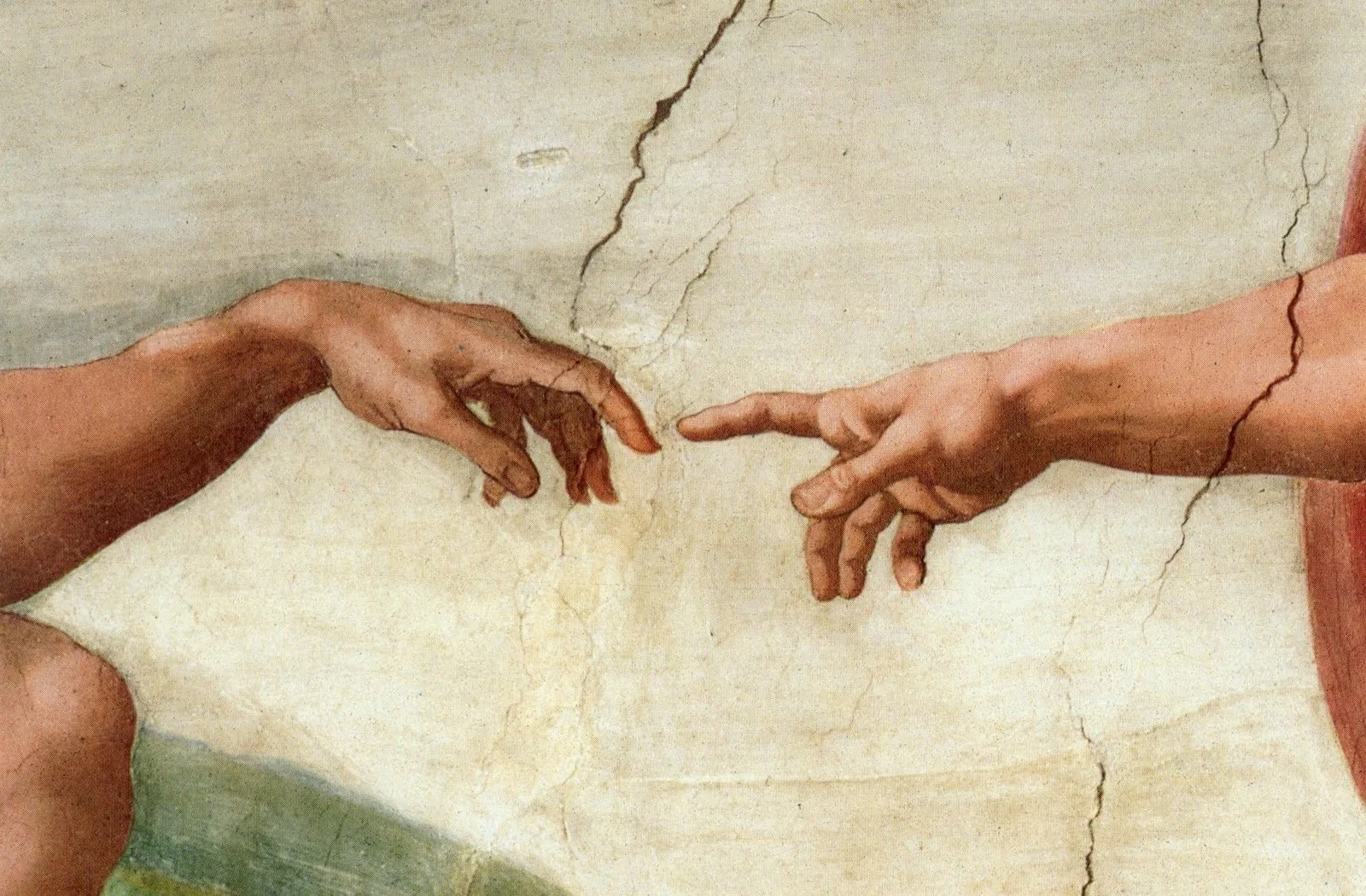
Our awareness of the distance between humanity and a holy God recalls the famous image from Michelangelo’s painting of the Creation. God and Adam are reaching out to each other with fingers extended but not touching. “In Israel, however, unlike the Sistine Chapel,” notes one commentator, “they do make contact!”
Parashat Vayikra: Leviticus 1:1–5:26
Ben Volman, UMJC Canadian Regional Director
The closing sentences of Exodus are like the finale of a great symphony. The epic story of Israel transformed into a nation united with God in the covenant at Mount Sinai concludes with a thunderclap of visible divine power. The Tabernacle, where Israel is meant to fully experience and sustain their new relationship with God, is so filled with the Presence of the Lord that Moshe is unable to enter. There is a further note concerning this Presence, that Israel would not move until they were led by the cloud “throughout all their journeys” (Exod 40:36).
In contrast, the opening of Leviticus, which begins at the moment when Exodus concludes, can seem mysteriously subtle and poetically crafted. Vayikra el-Moshe vaydaber Adonai elav (“Now Adonai called to Moshe and spoke to him,” v. 1). The opening word of the text brings us back to that familiar yet unique call that Moses first heard at the burning bush. According to Rashi, the sound of this call can be compared to the voices “that ministering angels employ.” Nachmanides describes the call as a word of “affection and endearment” to his servant and, by extension, to all those who respond to its message.
Israel remains camped at the foot of Mt. Sinai and goes no further in the pages of Leviticus. Yet Vayikra is a call for Israel under the cloud of the Presence to take a personal journey into the depths of God’s wellspring of chesed v’shalom, lovingkindness and peace. As Nachmanides suggests, it is God’s caring invitation for all who entered the covenant at Sinai to draw close in worship, prayer, and obedience to his word. The invitation is openly addressed to “adam,” properly translated as “anyone.” Men and women alike are welcome; despite their hesitations from failure, broken relationships, sin and shame, they will be received with respect and dignity. Despite the overwhelming details of the sacrifices, the purpose was to remove the barriers between us and our Creator.
Our modern concept of a sacrifice is usually focused on the value of what we’ve given or given up. Here, the word for offering, korban, is derived from the root karav, which means “close” or “near.” The korban brings us near with the purpose of showing reverence or paying homage. The material value of the offering is not important. This act of drawing near must also take place in the heart of the worshiper, coming with the right intentions and attitudes. As the psalmist writes, “The sacrifices of God are a broken spirit. / A broken and a contrite heart, O God, / You will not despise” (Psa 51:19).
Leviticus begins by describing voluntary offerings or gifts from anyone who has a need or impulse to seek God, whether one had completed a vow, sought help in times of distress, or wished to celebrate in gratitude. The first offering described here is the olah or burnt offering. Olah, meaning “to ascend,” reflects the distinctive aspect of sacrifices on the altar which rise to heaven as smoke. It is completely consumed on the altar and represents the unreserved devotion of one who comes to worship. This is the offering that Noah gave after the flood and that Abraham brought after the binding of Isaac. The offering was a healthy, domesticated animal “without defect” from one’s herds or flocks, but if one could not afford this, an inexpensive bird or fowl was sufficient. If one was utterly reduced in poverty, even a handful of flour would suffice.
The worshiper would be received by the priest in order to understand their reasons for coming and then have them lay their hands on the offering. The Hertz Chumash comments that no offering would be made in silence and from the beginning the priests must have required prayer and confession with the “laying on of hands.” Walter Brueggemann suggests that we may be hearing the voices of these confessions in the penitential psalms, such Psalms 6, 32, 51, and 130.
In his commentary on the sin offerings in Leviticus, Nachmanides tells us there is to be a complete identification with the sacrifice as a substitute: a life given for our life, which would not be spared “were it not for the lovingkindness of the Creator.” Afterwards, blood of the offering is poured out for the priest, who completes the necessary preparations for atonement. The principle is stated in Leviticus 17:11: “For the life of the creature is in the blood . . . it is the blood that makes atonement.” Depending on the era in which the sacrifice took place, blood was applied either to the horns of the altar or literally splashed on the corners of the altar covering every direction. In either case, the symbolic meaning is beautifully reflected in Psalm 103:12: “As far as the east is from the west / so far has He removed our transgressions from us.”
When Walter Bruegemann describes our innate awareness of the distance between humanity and a holy God, he recalls the famous image from Michelangelo’s painting of the Creation. God and Adam are reaching out to each other with fingers extended but not touching. “In Israel, however, unlike the Sistine Chapel,” he notes, “they do make contact!”
The assurance of atonement, the full reconciliation between the worshiper and their Creator, is the most powerful aspect of these passages in Leviticus. Our inward journey is complete because the barriers that have separated us from God and also from one another are lifted. Voluntary offerings to provide personal restoration with others are described in Leviticus chapter 3 as shelamim. The word is variously translated as “peace,” “thanksgiving,” or “well-being” offerings. They began with the same rituals as the burnt offering, but only a small piece of the sacrifice was placed on the altar. Apart from the portion due to the priest, the rest was shared as a solemn celebratory meal shared by one’s family and invited guests as an act of community reconciliation.
It is unfortunate that the spiritually rich message of Leviticus has largely been lost in an age longing for connection. Lori Gottlieb, who writes an advice column for the New York Times, Ask the Therapist, receives thousands of letters each week from people who feel too isolated to turn elsewhere. She has come to understand that in this age of constant digital connections there is a deep dissatisfaction. Most of those questions, she says, convey the same essential need: “How do I connect? And how do I feel seen, heard, understood, valued, and respected?”
During these challenging times, most of us are overwhelmed by floods of information and social media that distract us from following our hearts to make those needed spiritual inward journeys. Let’s recall our ancestors who were ascending up to the Temple with their offerings and probably carried in their hearts emotions and struggles similar to those we are feeling now as they sang from Psalm 130:
Out of the depths I cry to You, Adonai!
Lord, hear my voice!
Let Your ears be attentive to the sound of my supplications.
If You, Adonai, kept a record of iniquities—
my Lord, who could stand?
For with You there is forgiveness,
so You may be revered.
I wait for Adonai, my soul waits,
and in His word I hope. . . .
He will redeem Israel
from all its iniquities. (Psa 130:1-5, 8)
All Scriptures citations are from the TLV.
.