
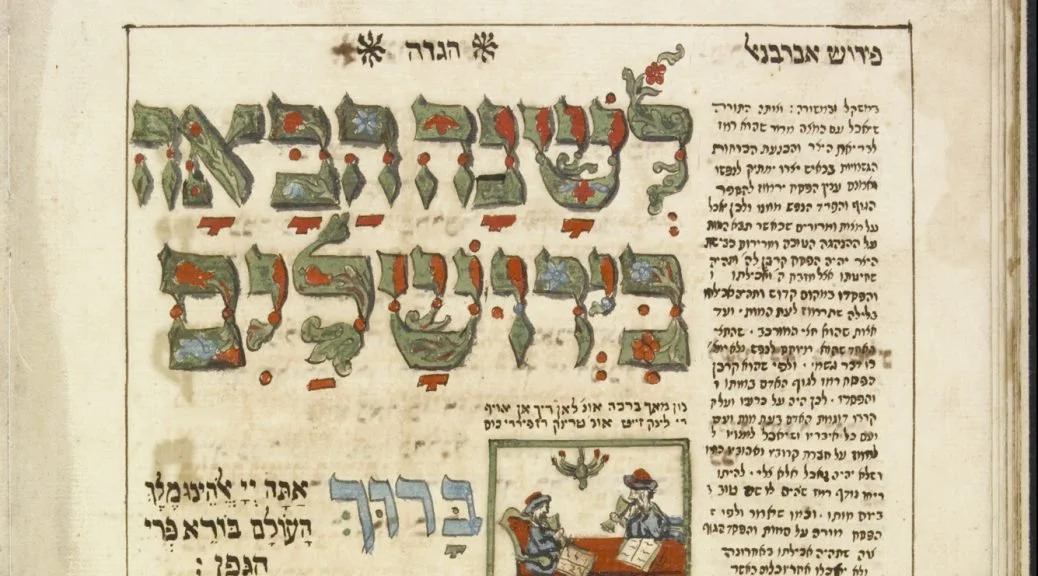
“Next year in Jerusalem” Photo credit: Passover Haggadah by BiblioArchives / LibraryArchives
Parashat Va’era, Exodus 6:2–9:35
Chaim Dauermann, Brooklyn, NY
Perhaps you, like I, have noticed that this week’s parasha feels like somewhat of a mirror of this week’s events. As the Iranian people struggle for something better after years of tyrannical oppression, we find a similar motif playing out in the Torah. Here, too, the Israelites strain under tyranny, and look toward a better future. We know that freedom for the children of Israel is just a few chapters away. We can only hope that good news comes out of Iran soon.
Of course, the story of the plagues is familiar for other reasons as well. After all, we read it at least twice a year—once with the parasha cycle, and again at Pesach. But familiarity should never be confused with predictability. The ancient Greek philosopher Heraclitus famously observed, “No man ever steps in the same river twice, for it’s not the same river, and he’s not the same man.” So too with Torah. When we return to a parasha each year, we are different, as are our circumstances, and so the Torah reveals itself anew. The plagues progress according to what seems like a pattern: Moses’s appeal, Pharaoh’s refusal, a plague inflicted; Pharaoh relents, and then he hardens again. But not all is as it seems. Upon a close reading when we get to the fourth plague—flies—something new emerges. It is now that Moses quietly draws our attention to a detail that has implications that reach far beyond the Exodus narrative.
First, God says, “I will set apart the land of Goshen, where My people are dwelling” (8:18) so that no flies will be there. And then he says something that sounds similar to this, but is distinct: Ve-samti pedut bein ammi u-vein amekha. “I will make a distinction between My people and your people” (8:19). Of particular interest here is pedut, the noun translated as “a distinction,” but with a more literal rendering would be “ransom” or “redemption.” The verbal root padah carries the same meaning, with an emphasis on the ransom having an exchange of value, or a substitution. This mention in Exodus is the first appearance of the padah root in the Tanakh, but it goes on to appear repeatedly throughout the text. Significantly, it features prominently in mentions of both the redemption from Egypt, and a greater redemption to come, when the whole of Israel is regathered at the time of the Messiah. As the prophet Zechariah writes, “I will signal for them and gather them. Surely I will redeem (padah) them” (10:8).
The symmetry between redemption from Egypt and the redemption in and through the Messiah is a common motif in the Brit Chadashah, but Yeshua’s emissaries were not innovators in this area. The parallel between redemption from Egypt and redemption to come in the Messiah, and the sense of expectation it fosters, finds its first expression the Tanakh, but Jewish tradition has carried it forward through time and ensured its continued prominence.
For example: the Babylonian Talmud records an exchange between second-century contemporaries and frequent debaters Eliezer ben Hyrcanus and Yehoshua ben Hananiah. Their conversation casts some light onto the parallel between the redemption in the past and the one to come. In discussing the timing of the Messiah’s coming, Rabbi Eliezer observes, “in Nisan the Jewish people were redeemed from Egypt; and in Tishrei in the future the Jewish people will be redeemed in the final redemption with the coming of the Messiah.” Rabbi Yehoshua counters with his own suggestion, that “in Nisan in the future the Jewish people will be redeemed in the final redemption” (Rosh Hashanah 11a). While they disagree on the timing, the two rabbis agree on the expectation and the association: There is a final redemption in Messiah, and it echoes the redemption from Egypt. A more familiar carrier of this tradition is this: At the end of every Passover seder, we sing “L’Shana Haba’ah B’Yerushalayim!” Next year in Jerusalem. This doesn’t speak of a casual visit, but rather the end of a long sojourn for the people of Israel, a return home at the anticipated time of regathering.
In Isaiah 11, the prophet writes of the Root of Jesse—the Messiah—who “will stand as a banner for the peoples. The nations will seek for Him, and His resting place will be glorious. It will also come about in that day that my Lord will again redeem—a second time with His hand—the remnant of His people who remain” (Isaiah 11:10–11a). For those of us who trust in Yeshua and follow his teachings, this future regathering is neither mysterious nor distant. Like the Israelites who experienced an initial pedut amidst the plague of flies while they were yet slaves, so we, too, get a foretaste of the great redemption foreseen by the prophets when we look to Yeshua, “who gave Himself as a ransom for all” (1 Tim 2:6). The experience of being Yeshua’s disciple is to live within a redemption that is both already, and not yet. As John writes: “Loved ones, now we are God’s children; and it has not yet been revealed what we will be” (1 John 3:2).
As we go about our walk of faith, we need not limit ourselves to taking the long view, looking only to what is to come once Messiah returns. Though we—and all creation—groan with this expectation, the Scriptures remind us that redemption does not begin at the end. Just as Israel experienced an initial pedut in Egypt, made distinct by redemption even while still enslaved, so we, too, are invited to live within the redemption God has already enacted in Messiah. The disciple’s life is shaped not only by anticipation, but by participation: learning to recognize what God has done, what he is doing now, and how we are to live as his redeemed people today. Our ransomed life is now.
All scripture quotations taken from the TLV.