
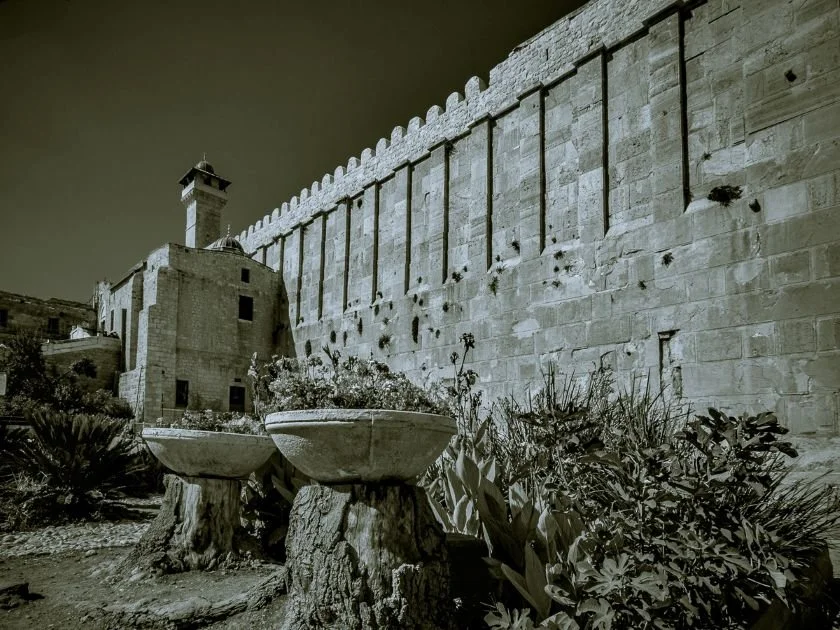
Cave of Machpelah in Hebron
Chayei Sarah, Genesis 23:1-25:18
Russ Resnik, UMJC Rabbinic Counsel
The narrative of Abraham and his line is undoubtedly told from a patriarchal perspective, yet it bestows special honor upon a matriarch, Sarah. Her death is the first recorded among the chosen household and she becomes the first one of Abraham’s line to be buried in the land promised to him, in the cave of Machpelah, which remains a holy shrine to this day (Genesis 23:19–20).
Sarah's life span is recorded in unusual detail as our parasha opens:
Now Sarah’s life was one hundred years and twenty years and seven years: these were the years of Sarah’s life. And Sarah died in Kiryat Arba, which is now Hevron, in the land of Canaan. And Abraham came to lament for Sarah and to weep over her. (Genesis 23:1–2)
Before Sarah dies, however, Abraham learns of the birth of Rebekah, daughter of his kinsman Bethuel (Genesis 22:20–22). The Sforno notes this connection in his commentary:
After Rebekah—who is fit to replace Sarah—is born, and Abraham is notified, Sarah dies. As our Sages tell us [in the Talmud, Yoma 38b], "One righteous person does not die before another is born, as it is written, and the sun rises, and the sun sets” (Ecclesiastes 1:5).
The lives of women are not at all superfluous in the patriarchal account. After Sarah dies, therefore, Abraham seeks to restore the essential feminine element in his family by finding a bride for Isaac. Indeed, the title of this parasha, Chayei Sarah, means, “Sarah lives.” It begins with a burial but continues through the betrothal of a new matriarch. Sarah will live on through the wife of Isaac.
To find this woman, Abraham sends a servant back to his land and kindred. The entire story of the betrothal of Isaac and Rebekah hinges upon the actions of this servant, yet he is never named. He is called simply “the servant of Abraham.” His role is vital, and yet the attention is never on him. Rather, the narrative focuses on Rebekah, who is revealed as a worthy successor to Sarah through her extravagant hospitality (Genesis 24:14–21) and bold determination to join the line of Abraham (Genesis 24:54–58).
In Chayei Sarah, the unnamed servant brings together the bride and groom, serving as a sort of best man. In an earlier wedding the best man was the Lord himself, who formed Eve from the side of Adam and brought her to him. Rabbi Abin said of this event, “Happy the citizen for whom the king is best man!” (Midrash Rabbah, Gen. 18:3). And even before it pictures this primordial wedding, the Torah says that God blessed the man and woman that he had created (Gen. 1:27-28). Commenting on these verses, Rabbi Abbahu said, “The Holy One, blessed be he, took a cup of blessing [essential to the traditional Jewish wedding] and blessed them” (Midrash Rabbah, Gen. 8:13).
Helping to arrange a wedding and attending the bridal couple are acts of kindness, or gemilut hasadim and the Lord himself provides the example of such acts so that we can emulate him.
R. Hama said in the name of R. Hanina: What does it mean, “You shall walk after the Lord your God”? (Deut. 13:5). Is it possible for a person to walk and follow in God’s presence? . . . But it means to walk after the attributes of the Holy One, blessed be he.” (Talmud, Sotah 14a)
Abraham’s unnamed servant shows that he is a true follower of the Lord as he follows his example of kindness in bringing together the bridal couple. Such acts of kindness form the fabric of community. Furthermore, they provide a foretaste of the age to come, when all human needs will be fully met, and there will be none who are naked or lonely or abandoned. Therefore, we are instructed to support others in joyous events such as a wedding, as well as in sorrowful events such as sickness or mourning: “Rejoice with those who rejoice, and weep with those who weep” (Romans 12:15).
By marrying Rebekah, Isaac receives comfort after the death of Sarah, takes on the legacy of his father Abraham, and ensures that the divine covenant will be passed on to another generation. The Midrash comments that when Sarah died, the cloud of God’s presence upon her tent departed; when Isaac brings Rebekah his bride “into the tent of his mother Sarah” (24:67), the glory-cloud returns (Gen. Rab. 60:16).
The union of Isaac and Rebekah is a uniquely significant wedding, but it highlights the significance of every wedding in the sight of God. Every time we attend a wedding we agree with God that it is not good for the man (or woman) to be alone, that both bride and bridegroom are to bear a divine blessing, and that their marriage is to be fruitful in many ways. At such events we are not to be a mere audience, but we are to be community, supporting the couple and adding our own blessing to the Lord’s blessing.
It is no wonder then, that early in his account of the deeds of Messiah, Yochanan records Yeshua’s attendance at a wedding, where he turns the ordinary drinking water into fine wine. Yochanan wraps up the story: “This beginning of signs Yeshua did in Cana of Galilee and manifested his glory; and his disciples believed in him” (John 2:7–11).
The phrase “beginning of signs” brings us back again to B’reisheet, the beginning. There, “The Holy One, blessed be he, took a cup of blessing and blessed them.” Here, Yeshua, Son of the Holy One, ensures an abundant supply of wine for a Galilean wedding. Wine in this context is not just refreshment, but the emblem of the blessing and divine favor that will issue in fruitfulness for the new couple. It is not just a social embarrassment for a family to run out of wine, but a threat to the peace of the new couple, and to the continuity of the community.
The God of Torah is not an impersonal “First Cause,” but a God of compassion. He is not distant from the world he created and the human beings he has placed within it. Rather, it seems that he can hardly stay away from us. He is ready to enter our world, to feel our sorrows, and to share in our joys. And in Messiah, he steps fully into the community of men and women to embody the acts of kindness he has modeled since the beginning.
Thus our parasha this week provides two examples to guide us: first, the Lord's example as he engages in acts of kindness that create and sustain community; and the example of Sarah, the mother of Israel, which the Lord puts before us:
Listen to me, you who pursue righteousness,
you who seek the Lord:
look to the rock from which you were hewn,
and to the quarry from which you were dug.
Look to Abraham your father
and to Sarah who bore you . . . (Isaiah 51:2)
The Midrash claims that “Abraham was subsidiary to Sarah in the matter of prophecy” (Exod. Rab. 1:1), perhaps because she sustains her vision through steady, long-term, behind-the-scenes faithfulness. Abraham’s faith is heroic, but Sarah’s faith prevails through the times of challenge and perseverance that we so often experience as we “pursue righteousness” and “seek the Lord.”
And so, Sarah lives on and her example continues to guide us today.