
Will Our Repentance Reach Its Goal?
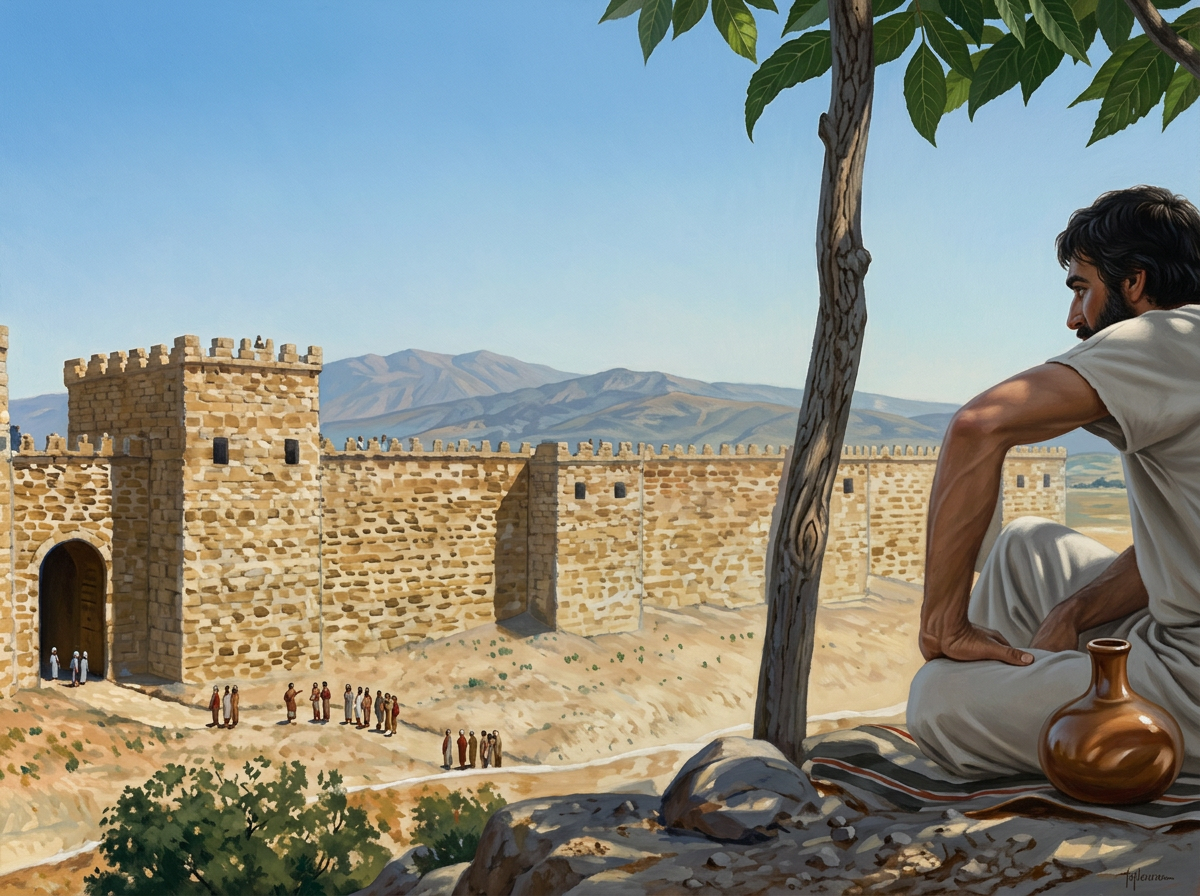
Image: Biblehub.com
Yom Kippur 5787
Russ Resnik, UMJC Rabbinic Counsel
Toward the conclusion of the Days of Teshuvah or Repentance, on the afternoon of Yom Kippur, it’s customary to read and ponder the book of Jonah, which provides a master lesson in the meaning and power of repentance.
There’s a paradox here, though, because it’s not clear whether the protagonist, Jonah himself, fully repents in the end. The book opens with the word of the Lord directing Jonah, “Arise, go to Nineveh, that great city, and cry out against it.” Jonah responds by heading in the opposite direction. He goes down to the port of Jaffa and then down into a ship headed for Tarshish, “away from the presence of the Lord,” and finally down into the ship’s hold to take a nap (Jonah 1:1–5).
Everyone knows the story: Jonah’s escape from his divine assignment doesn’t work out so well. A storm arises, threatening to break up the ship, and Jonah is cast into the sea to calm it. He’s swallowed by a great fish, where he remains, fully conscious, for three days. Jonah finally appears to repent, saying, “What I have vowed I will pay” (Jonah 2:9). The Lord speaks to the fish; it vomits Jonah out on dry land; Jonah is recommissioned and he heads out for Nineveh. When he arrives, he brings the warning God had directed him to give: “In forty days Nineveh will be overthrown” (Jonah 3:4).
The Ninevites immediately repent with great earnestness, and it looks like they’ll be spared the terrible judgment that Jonah warned them about. And he can’t stand it. He’s infuriated over God’s impending act of mercy and tells God that he never wanted to go to Nineveh because, he says, “I knew you were a God who is merciful and compassionate, slow to anger and rich in grace, and that you relent from inflicting punishment” (Jonah 4:2). He storms out of town, builds himself a shelter—a sukkah— and sits down to watch over the city, hoping it will be judged after all.
The Lord provides a castor bean plant to shade the recalcitrant prophet in his flimsy shelter and then sends a worm to attack the plant so that it shrivels up and dies. The text continues,
Then, when the sun rose, God prepared a scorching east wind; and the sun beat down on Jonah’s head so hard that he grew faint and begged that he could die, saying, “I would be better off dead than alive.”
God asked Jonah, “Is it right for you to be so angry about the castor-bean plant?” He answered, “Yes, it’s right for me to be so angry that I could die!” The Lord said, “You’re concerned over the castor-bean plant, which cost you no effort; you didn’t make it grow; it came up in a night and perished in a night. So shouldn’t I be concerned about the great city of Nineveh, in which there are more than 120,000 people who don’t know their right hand from their left — not to mention all the animals?” (Jonah 4:8–11)
And there the story ends. We never learn whether Jonah, the prophet of repentance, repents of his bitterness against the Ninevites. We don’t know whether he ever completes the teshuvah he began in the belly of the fish by coming to share God’s own heart for the human lives of Nineveh.
The story is left without a conclusion, but with an open question: God says, “Shouldn’t I be concerned about the 120,000 human souls in Nineveh?” The question invites Jonah to share in God’s concern and compassion, and it expands into a question for us. When we talk about teshuvah during this season, are we genuinely turning away from our own distractions and preoccupations and turning back to God and his concerns? Are we turning back fully enough to share in God’s own compassion for the real humans he created and watches over?
In the Union community during this season of teshuvah many of us have been seeing our need to return to our founding vision of a thriving movement for Yeshua within and among the Jewish community. This means shifting our focus away from our own priorities and preoccupations and seeking Messiah’s heart for his people. Yeshua expressed this passion while on his way to the holy city:
O Jerusalem, Jerusalem who kills the prophets and stones those sent to her! How often I longed to gather your children together, as a hen gathers her chicks under her wings, but you were not willing. (Luke 13:34)
Later, as Yeshua “drew near and saw Jerusalem,” Luke tells us,
He wept over her, saying, “If only you had recognized this day the things that lead to shalom! But now they are hidden from your eyes.” (Luke 19:41–42)
Let’s not miss the tenderness of this picture, of Yeshua’s yearning to gather the scattered children of Israel like a hen gathering her brood under her wings. Yeshua weeps over Israel’s sin and shortcoming, not in anger but with an agonized desire for her to return to her true place in God’s kingdom. He longs not only for Jewish individuals, but even more for the restoration of the entire people of Israel as foretold by the prophets.
Jonah is a remarkable reading for Yom Kippur, arguably the most Jewish day of the year, because it portrays deep repentance among a gentile nation, which serves as a paradigm for all the nations besides Israel, all humankind. Thus, on the Jewish holy day of Yom Kippur, we encounter in Jonah’s story the hope of teshuvah for all peoples.
But I also see a qal v’chomer argument here. This Hebrew phrase meaning “light and heavy” describes a principle of biblical interpretation, and here’s how it works: If the pagan Ninevites can repent so readily, how much more should we repent as well. If Jonah is called to embrace God’s compassion for these pagan Ninevites, how much more are we called to embrace God’s compassion for Israel. If God invites Jonah to long for Nineveh’s repentance, how much more are we to share in Messiah Yeshua’s longing for Jerusalem’s restoration.
May this vision of turning to the God of Israel and to his longing for the redemption of his people capture our hearts as this season of teshuvah reaches its completion.