
Sukkot: The Lord Dwells with Us
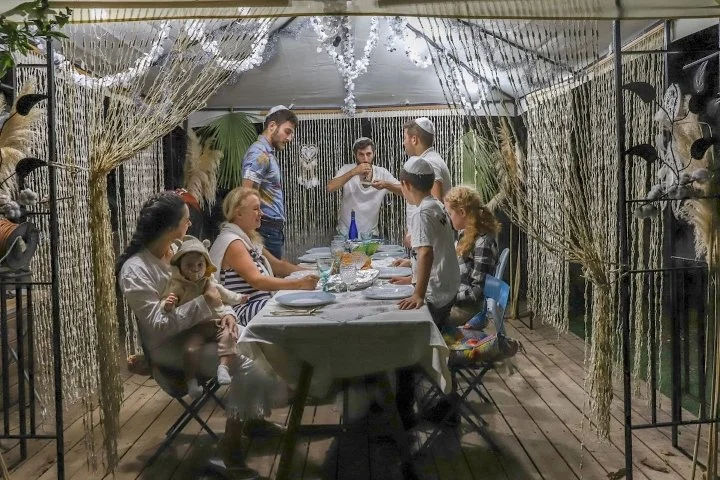
Sukkot 5787, Leviticus 22:26-23:44
Rabbi Jude, Kol Mashiach, Melbourne, Florida
Sukkot arrives each year as the last of the fall holidays, the last of the appointed times found in Leviticus chapter 23, and the last of the Shalosh Regalim, the three pilgrimage festivals. While it would be impossible to explore in depth all of the rich spiritual significance and meaning of this holiday, I hope to touch on some key points: the joy of Sukkot, the idea of Hashem dwelling with us, and how Sukkot is a fulfillment and redemption holiday. Within all of these points, we will see a picture of our Messiah Yeshua.
The Joy of Sukkot
In ancient Israel, the people were farmers whose livelihood was tied to a good harvest season. Sukkot falls at the time of the final harvest and is the season of ingathering, when you reap what you have sowed all season. We sing Psalm 118 during this time, which says “Give thanks to the Lord for he is good!” We wave the four species – the lulav, hadas, arava and etrog (branches of palm, myrtle and willow, plus a citron) – which symbolize the harvest and our thanksgiving and worship of the Lord. As we remember our ancestors’ harvest at this time of year, we can imagine how joyous it was for them to reap what they had sown. In fact, one of the many names for this holiday is Z’man Simchatenu – the time of our joy.
During the time of the second temple, there was a ritual called the water-pouring or libation ceremony. This event happened on Hoshanah Rabbah, the last and greatest day of Sukkot. The priest would take a water pitcher to the Pool of Siloam in Jerusalem and dip it into the water. Then the priest would bring the pitcher back to the temple, circle the altar, and then pour the water on the altar. Crowds of people would follow the priest’s journey back and forth, singing the Hallel (Psalms 113-118). In the Talmud (tractate Sukkah 51a), it says, “one who did not see the Celebration of the Place of the Drawing of the Water never saw celebration [joy] in his days.” We see the words of the prophet Isaiah come to life here: “With joy you will draw water from the wells of salvation” (Isaiah 12:3).
When Yeshua was in Jerusalem attending the water libation ceremony on Hoshana Rabbah, he attributed these waters of salvation to himself:
On the last day of the feast, the great day, Yeshua stood up and cried out, “If anyone thirsts, let him come to me and drink. Whoever believes in me, as the Scripture has said, ‘Out of his heart will flow rivers of living water.’” (John 7:37-39)
So, during this joyous holiday of Sukkot, we also remember the joy we have in knowing Yeshua the Messiah – our living water.
The Lord Dwelling with Man
During Sukkot, we are instructed in Torah to dwell in temporary structures or booths:
You shall dwell in booths for seven days. All native Israelites shall dwell in booths, that your generations may know that I made the people of Israel dwell in booths when I brought them out of the land of Egypt: I am the Lord your God. (Leviticus 23:42-43).
The word in Hebrew for booths is “sukkot,” which is plural for a sukkah. We make these temporary structures each year at this time, reminding us of how our ancestors dwelled in temporary structures in the wilderness for forty years. We are also reminded how Yeshua took on a temporary earthly structure (human flesh) and chose to dwell with man: “And the Word became flesh and dwelt among us, and we have seen his glory, glory as of the only Son from the Father, full of grace and truth” (John 1:14).
As we dwell in our sukkahs this Sukkot, let us remember that God dwells with us and within us in the person of Yeshua our Messiah.
Fulfillment and Redemption
Rabbi Arthur S. Waskow, in his holiday book Seasons of Our Joy, says Sukkot is “the festival of fulfillment, of gathering in the benefits that flow from repentance and forgiveness. The harvest that takes the form of joy and shalom, harmony, in the world.” Sukkot is a closing holiday in many ways. It’s the final holiday of the fall festivals. It’s the last of the major holidays outlined in Leviticus 23. And it is also the capstone and fulfillment of the “Big Three” holidays in Judaism (Passover, Shavuot, and Sukkot) we call the Shalosh Regalim. Of all the holidays, these were the three times each year when Jewish people throughout the world would temporarily leave their homes in the diaspora and make aliyah (go up) to Jerusalem to meet with Hashem.
There is a beautiful spiritual parallel between the Shalosh Regalim and the blessings surrounding the Shema in our shacharit liturgy. The Shema and its blessings consist of two blessings before and one blessing after our declaration of faith in one God. The first blessing extols God as Creator and corresponds to the spring holiday of Passover. On Passover, God is said to have created or birthed the Jewish nation as he miraculously brought them out of Egypt. The second blessing, Ahava Rabbah, showcases God’s great love for his people Israel and is represented by Shavuot, the second of the Shalosh Regalim. On Shavuot, God made a covenant with Israel at Sinai. This is the holiday of revelation, when God gave us the Torah.
This brings us to the final holiday in the Shalosh Regalim. Sukkot is the culmination and fulfillment holiday that ultimately shows us the theme of redemption. One of the definitions of redemption or to redeem is to recover from captivity. As the Israelites were leaving Egypt, after years of captivity, they were being pursued by the Egyptian army, with its warriors, weapons and chariots. Things didn’t look good for the Jewish people. But then the Lord miraculously parted the Red Sea, so the Israelites could walk across on dry ground. And just as miraculously, God brought the waters back right as the Egyptians entered the seabed, drowning the invading army and rescuing Israel. We remember this in our liturgy with the final blessing after the Shema, the blessing of redemption, when we say, “Mi chamocha b’elim Adonai” – Who is like you, O Lord, among the gods?
The Shalosh Regalim, in parallel with our morning liturgy, show us God as creator on Passover, revealer on Shavuot, and redeemer on Sukkot. It is within this context of redemption that we can see our Messiah Yeshua. Upon entering his hometown of Nazareth, Yeshua went to the synagogue and was given the scroll of Isaiah which he attributed to Himself:
The Spirit of the Lord is upon me, because he has anointed me to proclaim good news to the poor. He has sent me to proclaim liberty to the captives and recovering of sight to the blind, to set at liberty those who are oppressed. (Luke 4:18)
Yeshua came to set the captives free from their sins. He came to redeem both Israel and the nations.
So, as we enter this holiday of Sukkot, let’s remember the joy we can have in the Lord through Yeshua as our Messiah. As we dwell in our sukkahs, let’s remember how the Lord dwells with us in Yeshua. And as we see Sukkot as the final fulfillment holiday in our annual cycle, let’s remember how Sukkot points us to our final and complete redemption found in Yeshua our Messiah.